














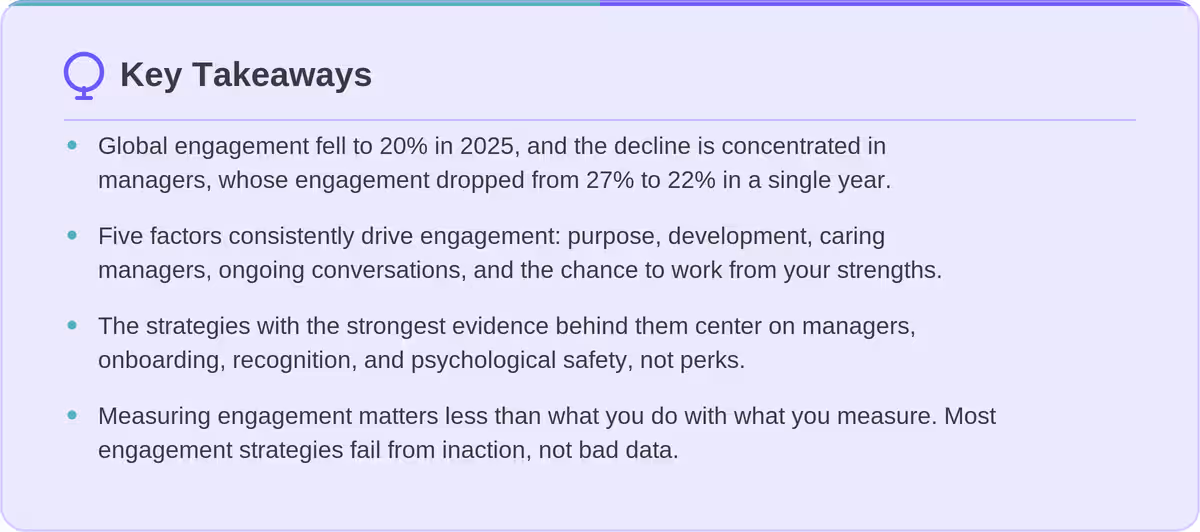
Only 20% of employees worldwide were engaged at work in 2025, according to Gallup's State of the Global Workplace report, the lowest level since the pandemic and the second straight year of decline. That means roughly four out of every five employees are either going through the motions or actively checked out. Gallup estimates the global cost of that disengagement at $10 trillion in lost productivity a year, roughly 9% of global GDP.
The strategies below are organized around what Gallup's own research shows actually moves that number: what drives engagement in the first place, which tactics have measurable evidence behind them, how to measure whether any of it is working, and why so many engagement efforts quietly fail.
If you're searching for how to improve employee engagement across an entire workforce or how to increase employee engagement on one struggling team, the same underlying drivers apply. None of this replaces knowing your own people. It gives you an evidence-based starting point instead of a guess.
Prefer to watch? Here's the 8-minute version, covering the 7 strategies with the strongest evidence behind them. The written guide below covers all 15, with every source linked.
What Is Employee Engagement?
Employee engagement is the emotional connection and commitment an employee feels toward their work and their organization. Gallup, which has tracked the concept longer than almost any other research body, defines it as the involvement and enthusiasm employees bring to their work and their workplace.
For a fuller breakdown of the concept itself, see our guide to what employee engagement actually means.
An employee engagement strategy is the deliberate, repeatable set of actions an organization takes to build that connection on purpose, instead of leaving it to chance. The difference matters. A single recognition event or one well-run town hall is an initiative. A strategy is what happens when you turn a handful of employee engagement initiatives into an ongoing employee engagement program: you decide, in advance, which actions you'll repeat, how often, and how you'll know if they're working.
Larger organizations often run several employee engagement programs in parallel, one for recognition, one for onboarding, one for manager development. Some go a step further and formalize the whole effort into a written employee engagement plan with an owner and a timeline attached to each initiative, which makes it easier to hold the work accountable once the initial enthusiasm fades.
Why Employee Engagement Strategies Matter
.avif)
Knowing what a strategy is doesn't answer why it's worth building one in the first place. Engagement is not a soft metric. Gallup's own research compares business units in the top quartile of engagement to those in the bottom quartile, and the outcome gaps are large and consistent across industries.
These are median differences across Gallup's database of company comparisons, not a guarantee for any single organization. But the direction and consistency of the pattern, across profitability, safety, quality, and turnover at once, is why engagement strategy sits with the CEO and the board, not only with HR. The connection between employee engagement and retention shows up especially clearly here: a workforce engagement problem rarely stays contained to morale. It shows up in exit interviews within a year or two.
The Real Drivers of Employee Engagement
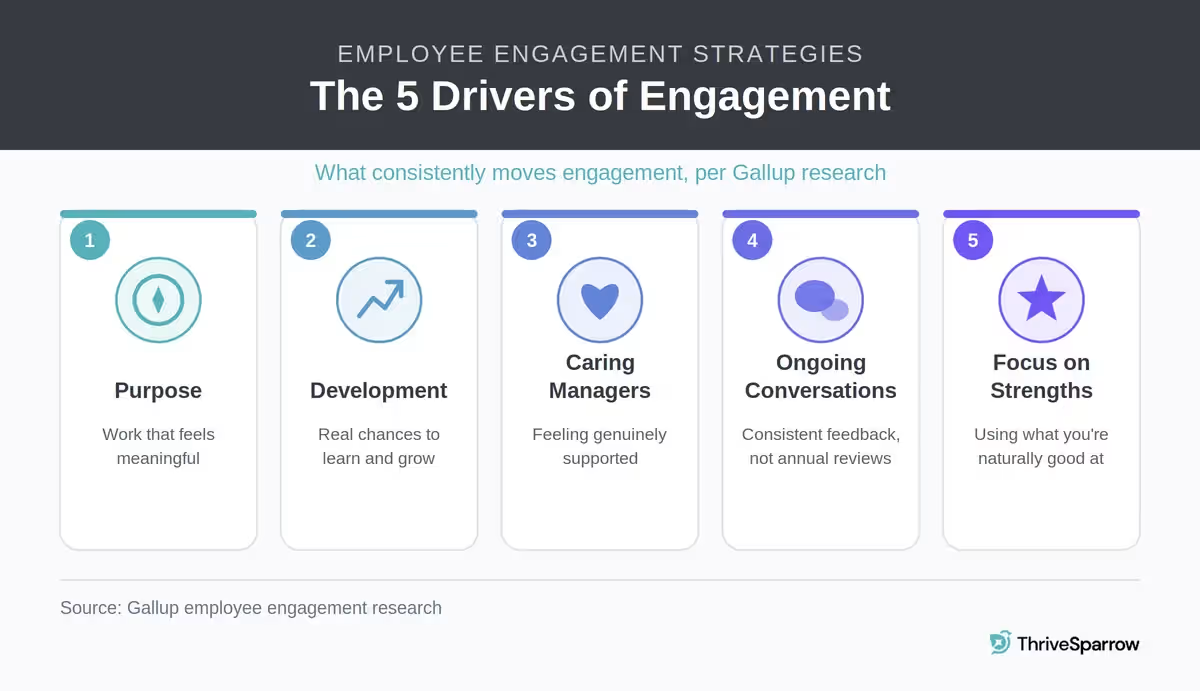
Given how much is riding on it, the obvious next question is what actually moves the number. Most engagement problems, whether you call it staff engagement, workplace engagement, or simply work engagement, trace back to a small number of root causes. Decades of Gallup's employee engagement research point to five factors that consistently drive engagement across organizations:
- Purpose. Doing work that feels meaningful and connected to something larger than the task in front of you.
- Development. Having real, visible opportunities to learn and grow.
- Caring managers. Feeling genuinely supported by someone who knows you as a person, not just a role.
- Ongoing conversations. Getting consistent feedback and coaching, not just an annual review.
- Focus on strengths. Being encouraged to use what you're naturally good at, every day, rather than only working on weaknesses.
One driver deserves special attention. Gallup has found that the manager alone accounts for 70% of the variance in team-level engagement, more than any other single factor.
That statistic explains a specific and current problem: Gallup's 2026 report found that manager engagement fell from 27% in 2024 to 22% in 2025, a much sharper drop than among individual contributors, whose engagement stayed comparatively flat. When the people responsible for 70% of the variance in engagement are themselves losing engagement fastest, that's not a side issue. It's close to the whole story.
A sixth driver worth naming separately is psychological safety, the belief that you can share an idea, ask a question, or admit a mistake without fear of punishment or humiliation. Google's internal Project Aristotle study of team effectiveness, which examined what separated its highest-performing teams from the rest, found that psychological safety was the single biggest factor, ahead of who was actually on the team.
15 Employee Engagement Strategies
Understanding the drivers is one thing. Turning them into action every week is another.
The 15 employee engagement ideas below aren't ranked, since which ones matter most will depend on where your organization's engagement gaps actually are. Start with a survey or a set of manager conversations to find yours before picking where to invest first.
For real-world employee engagement examples of several of these in action, or a comparison of employee engagement solutions that support them at scale, see the linked guides.
1. Build Trust With Transparent Communication
Employees disengage fastest in an information vacuum. When leadership explains not just what is changing but why, and gives a clear timeline for what's still undecided, people are far more likely to stay engaged through the change itself. Regular town halls, direct Q&A channels, and consistent updates during periods of uncertainty all reinforce the same thing: that the organization trusts its people enough to be honest with them.
2. Make Recognition Part of the Daily Rhythm
Recognition works best when it's frequent and specific, not saved for an annual awards ceremony. Peer-to-peer recognition, where colleagues can acknowledge each other directly, spreads appreciation across the organization instead of funneling it only through managers. The mechanism that makes this a genuine engagement driver, not just a nice gesture, is Gallup's own finding above: purpose and caring managers are two of the five core drivers, and consistent recognition is one of the clearest ways either shows up day to day.
3. Give Employees a Real Voice, and Act on What You Hear
Asking for feedback and then visibly acting on it (or explaining why you didn't) is one of the fastest ways to build or destroy trust. Surveys, focus groups, and open forums only build engagement if employees can see a line between what they said and what changed afterward. If that link isn't visible, feedback requests start to feel like a formality, and participation quietly drops the next time you ask.
4. Invest in Growth and Development
Development is one of Gallup's five core drivers for a reason: people who feel stuck disengage, regardless of how much they're paid. Mentoring programs, access to training, and support for certifications all signal that the organization sees an employee's future, not just their current output. This doesn't need to be expensive. A structured mentoring relationship costs far less than the turnover it can prevent.
5. Build Clear Career Paths
Career development works best when employees can actually see it, not just have access to it. A career lattice, where movement can be lateral or diagonal and not only upward, reflects how most careers actually progress today. Communicating internal openings, mapping out what skills a next role requires, and giving managers the tools to have real career conversations all turn a vague promise of "growth" into something concrete an employee can plan around.
6. Develop Your Managers Deliberately
Given that managers account for 70% of the variance in team engagement, and that manager engagement itself is currently declining faster than any other group, training managers to communicate clearly, give useful feedback, and resolve conflict isn't a nice-to-have. Of the 15 strategies here, this is the one most likely to move the overall number, precisely because of that 70% figure. Regular coaching-skill workshops, structured onboarding for new managers, and mentorship from experienced leaders all compound over time in a way that a single leadership seminar never will.
7. Build a Structured Onboarding Experience
Onboarding sets the tone for everything that follows, and most organizations still get it wrong: Gallup finds that only 12% of U.S. employees say their company does a good job of onboarding. The same research found that employees who describe their onboarding as exceptional are 2.6 times more likely to be extremely satisfied with their workplace. Effective onboarding goes well past paperwork: pairing a new hire with a buddy or mentor, setting 30/60/90-day milestones, and checking in regularly through the first year all measurably increase the odds that early enthusiasm turns into lasting engagement.
See our full employee onboarding best practices for the complete process.
8. Foster Psychological Safety
Teams where people are afraid to speak up don't just feel worse. They perform worse, because problems and half-formed ideas both go unspoken until it's too late to act on them cheaply. Leaders build psychological safety by modeling vulnerability themselves, responding to mistakes with curiosity instead of blame, and deliberately inviting dissenting opinions in meetings rather than just tolerating them when they show up unprompted.
9. Give Employees Real Autonomy and Ownership
Micromanagement is one of the fastest ways to disengage a capable employee. Autonomy doesn't mean an absence of direction. It means giving people real input into how they reach a goal, not only being told what the goal is. Flexible scheduling, room to experiment with a new approach, and involvement in setting team objectives all build the kind of ownership that top-down control never produces.
10. Support Employees' Whole-Person Wellbeing
Engagement and wellbeing move together, and an employee struggling physically, mentally, or financially cannot bring their full self to work regardless of how engaging the work itself is. Whole-person wellbeing support extends past traditional health insurance to mental health resources, financial wellness education, and, where possible, genuinely usable time off. This is a strategic investment in the outcomes described earlier in this piece, not a perk layered on top of them.
11. Protect Work-Life Balance
An employee who can never fully disconnect is on a path to burnout, and burnout is the direct opposite of engagement. Organizations protect balance by setting real boundaries around after-hours contact, encouraging people to actually use their time off, and having leaders visibly model those same boundaries themselves. A policy that exists on paper but isn't modeled by leadership rarely survives contact with a busy quarter.
12. Create Structured Opportunities for Peer Connection
Meaningful workplace relationships don't form automatically, especially on hybrid and remote teams, and they matter more than most organizations assume. Structured peer connection, through cross-departmental project rotations, employee resource groups, or simply regular informal check-ins, gives people a reason to feel part of a community rather than just a headcount. This kind of connection rarely happens on its own once a team is spread across locations. It has to be designed.
13. Align Individual Work to a Larger Purpose
Purpose is the first of Gallup's five drivers, and it's also the easiest one to lose sight of in the daily grind of deadlines. People perform better when they understand why their specific task matters, not just what the task is. Connecting individual work to a customer outcome or a company milestone, consistently and specifically rather than in one annual all-hands speech, keeps that connection alive between the big moments.
14. Use Technology to Personalize the Employee Experience
Clunky, outdated tools quietly signal that an organization doesn't value its employees' time, while smart, well-designed technology can remove friction and free up time for meaningful work. Beyond basic productivity tools, technology can personalize engagement at scale: surfacing relevant learning opportunities, delivering pulse surveys at a sensible cadence, and giving managers real-time visibility into how their own team is actually doing.
15. Measure Engagement Continuously, Not Once a Year
An annual survey tells you where engagement stood months ago. A short, regular pulse survey tells you where it stands now, while there's still time to act. This strategy is the bridge to the next section, since measurement without action changes nothing, but the reverse is also true: you cannot act on a problem you aren't tracking.
How to Measure Employee Engagement
Measurement only has value if it drives action, and it works best when you separate a small number of core indicators from the day-to-day signals that feed them.
Gallup's own measurement approach centers on the Q12, a set of 12 survey items covering the basics of engagement, such as knowing what's expected at work, having the right materials and equipment, and getting the chance to do what you do best every day. Gallup groups engaged employees into three categories worth knowing: engaged employees are psychologically invested and go beyond what's expected of them; not engaged employees show up and do the work but without real enthusiasm; actively disengaged employees are unhappy enough that their behavior can actively work against the team around them. Tracking the size of each group over time, not just a single average score, gives a far clearer picture than one aggregate number ever will.
Alongside a structured survey, a few supporting metrics are worth watching regularly:
- eNPS (Employee Net Promoter Score), a fast, low-friction way to check whether employees would recommend the organization as a place to work.
- Participation rate, since a declining response rate on your own pulse surveys is itself a signal that people don't believe their feedback leads anywhere.
- Retention and internal mobility, which connect engagement data to outcomes that finance and leadership already track closely.
For a deeper walkthrough of building this out, see our guide to how to measure employee engagement and our full breakdown of employee engagement metrics.
Why Employee Engagement Strategies Fail
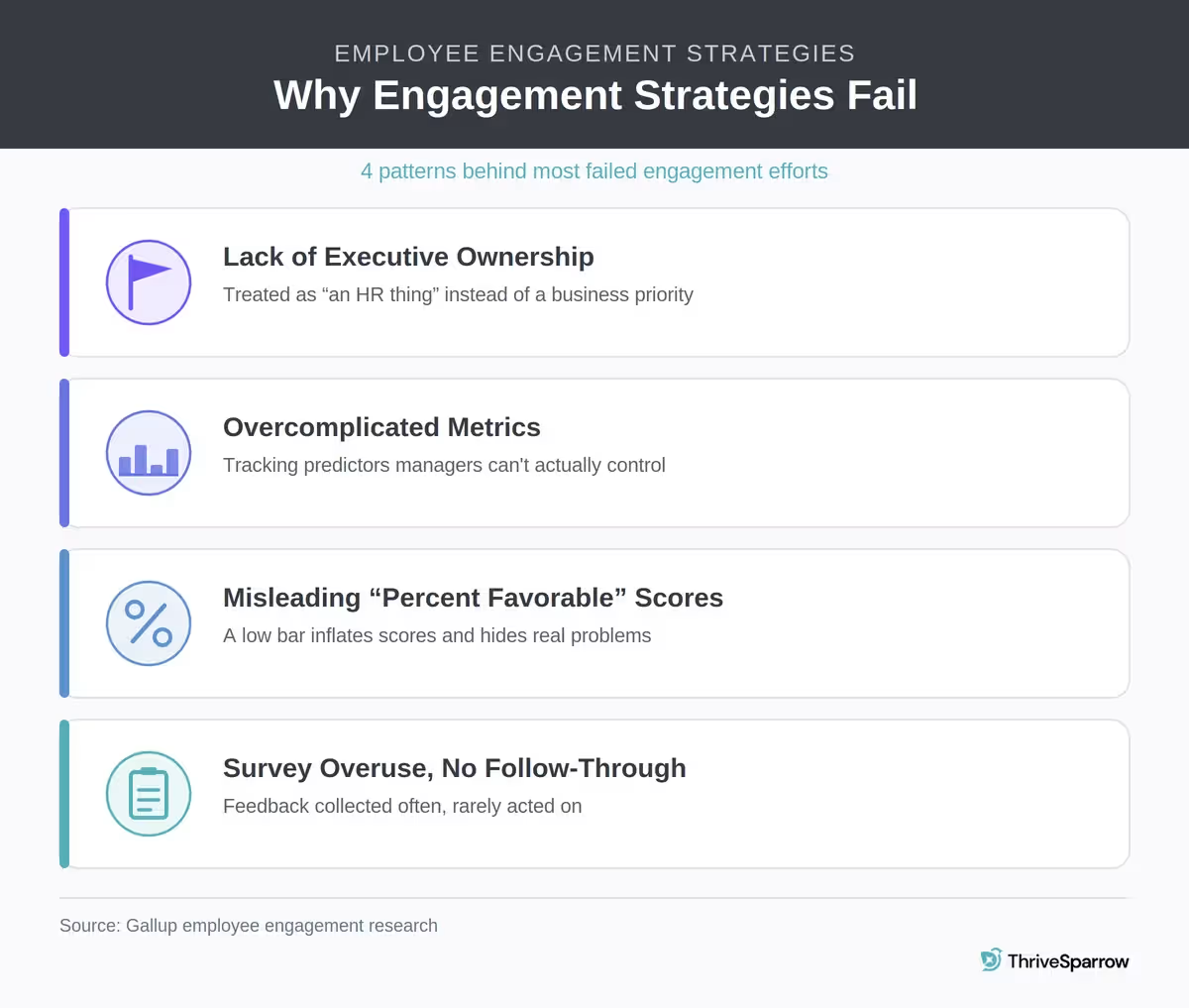
Even organizations that measure carefully can still watch a strategy quietly fall apart. Most engagement strategies don't fail because the underlying ideas are wrong. Gallup's research points to a more specific pattern:
- Lack of executive ownership. When leaders don't visibly model and prioritize engagement themselves, it gets treated as "an HR thing" rather than a business priority.
- Overcomplicated metrics. Some organizations track predictors so complex that managers have no real control over moving them, which quietly breaks the link between effort and results.
- Misleading "percent favorable" scores. A low bar for what counts as a positive response can inflate engagement scores while masking real problems underneath them.
- Survey overuse without follow-through. Pulse surveys get run frequently, but the feedback rarely turns into visible action, and participation erodes as a result.
The common thread across all four is the same: engagement strategies fail from inaction on what's already known, far more often than from a genuine lack of information about what to do next.
Where to Start, Not Everything at Once
Trying to run all 15 strategies at once is a reliable way to run none of them well. Start with a short engagement survey to find your organization's actual gap, then pick two or three strategies that address it directly, and give them real time before adding more.
The clearest employee engagement trends in Gallup's own data point consistently toward a few places that tend to matter most: manager development, structured onboarding, and consistent recognition. If you're not sure where to start, those three are a reasonable place to begin.
Here's what that looks like in practice.
Pimberly, a SaaS company with 51 to 200 employees, had no structured way to collect employee feedback before it started running an annual engagement survey alongside regular pulse polls in ThriveSparrow. The rollout took about a month, and one of the first concrete changes it produced was a new holiday policy, built directly from what employees said in a survey rather than a guess about what they'd want.
Emma Symons, the company's Office Manager and ESG Lead, says "collecting feedback and acting on it feels seamless" now. Pimberly is tracking year-over-year sentiment shifts and plans to add eNPS scores for ongoing benchmarking, the same continuous-measurement approach described earlier in this guide.
If you want to track engagement continuously rather than guessing between annual surveys, ThriveSparrow's employee engagement software is built to make that measurement part of the regular rhythm of work rather than a once-a-year event.
You can try it yourself with a free 14-day trial to see whether it fits your team.
.svg)
FAQs About Employee Engagement Strategies
1. What is the difference between employee engagement and employee satisfaction?
Employee satisfaction measures whether someone is content with their job. Employee engagement goes further: it measures whether they're emotionally invested enough to put in discretionary effort. A satisfied employee can still be disengaged; a genuinely engaged one rarely stays dissatisfied for long.
2. How long does it take to see results from an employee engagement strategy?
Some effects show up fast. A visible response to employee feedback can shift sentiment within weeks. Deeper drivers, like manager development or career pathing, tend to show measurable results over two to three quarters, since they depend on sustained behavior change, not a single announcement.
3. What is the single biggest driver of employee engagement?
No one factor works alone, but the evidence points most strongly to the manager relationship. Gallup attributes 70% of the variance in team-level engagement to the manager, which is why manager development consistently outperforms most other individual strategies on this list.
4. How often should you measure employee engagement?
Run a comprehensive survey annually or twice a year, and supplement it with shorter pulse surveys on a monthly or quarterly cadence. The comprehensive survey gives you depth. The pulse surveys give you the early warning an annual check-in alone cannot.
5. Can small businesses use the same employee engagement strategies as large enterprises?
Yes, though the scale changes. A 20-person company can build real manager relationships, transparent communication, and recognition without needing a dedicated software platform. The core drivers Gallup identifies (purpose, development, caring managers, ongoing conversations, and strengths) apply regardless of company size.


