










OKR scoring is how you measure progress toward an Objective based on how well its Key Results performed. It turns a goal from "did we do the thing?" into "how close did we get?". The most common approach: score each Key Result from 0.0 to 1.0, where 0 means no progress and 1.0 means full achievement. Say three equally weighted Key Results score 0.7, 0.6, and 0.8 — average them, and your Objective lands at 0.7. But calculating a score is the easy part. Choosing the right scoring method — and knowing what your number actually means — is where most teams get stuck.
This guide walks through how to score OKRs step by step, compares the scoring systems teams actually use, shows you how to interpret your results, and covers how to apply scoring consistently across a team.
What Is OKR Scoring?
OKR scoring is the process of evaluating how much progress you made toward an Objective, based on the results of its Key Results. Three parts make up the framework:
- Objective → What you're trying to achieve. This is the qualitative, directional goal — "Improve product reliability," not a number.
- Key Result → How you measure whether you achieved it. This is the quantitative piece — "Reduce bug-fix time from 10 days to 3 days."
- Score → The evaluation of progress against that Key Result, usually expressed as a number between 0 and 1, a percentage, or a pass/fail.
If you're still getting familiar with how Objectives and Key Results fit together as a goal-setting system, our guide to what OKRs actually mean covers that in more depth. This article picks up from there — assuming you already have OKRs in place — and focuses specifically on how to score them.
One quick clarification before moving on: "OKR scoring" and "OKR grading" are generally used interchangeably. Some teams say "grade" because it echoes the 0.0–1.0 scoring approach commonly associated with Google's OKR practice; others say "score" because it applies more broadly across scoring methods. Either term points to the same process. (If you're also weighing OKRs against KPIs as a framework, our KPI vs. OKR guide covers that distinction separately.)
How to Score OKRs Step by Step
Let's walk through the whole process using one running example: an Objective to "Improve customer support experience," tracked with three Key Results. We'll follow the first one — CSAT — from setup to final score.
Step 1: Define a measurable Key Result
Scoring is only meaningful if the Key Result itself can be measured. A vague KR gives you nothing to calculate against.
- ❌ Weak: "Improve customer satisfaction"
- ✅ Better: "Increase CSAT from 75% to 85%"
The weak version has no start point, no target, and no way to check progress mid-cycle — you're left arguing about whether "improved" happened at all. The better version gives you three fixed reference points: where you started (75%), where you're headed (85%), and a number you can check against at any point. If you want more worked examples of turning a fuzzy ambition into a measurable KR, our guide on how to write OKRs goes deeper on that step specifically. Without a measurable KR, scoring isn't measurement — it's opinion.
Step 2: Decide how you'll score the Key Result
Before the cycle starts, agree on which scoring system this KR will use — a 0–1 scale, a straight percentage, or binary pass/fail. Which one fits depends on the type of goal (we'll cover the differences between these systems, and when to use each, further down). For our CSAT example, we'll use the 0–1 scale, since it's a target you can partially achieve.
Step 3: Track progress through the cycle — don't wait until the end
This is the step teams skip most often, and it's the one that makes scoring reliable instead of a guessing game. If you only look at CSAT on the last day of the quarter, you have no idea whether you were trending up, stalled, or slipping the whole time — and no chance to intervene. Review progress regularly — often weekly or biweekly, depending on your team's OKR cadence. By the time you sit down to score, you should already know roughly where you'll land.
Step 4: Calculate the result
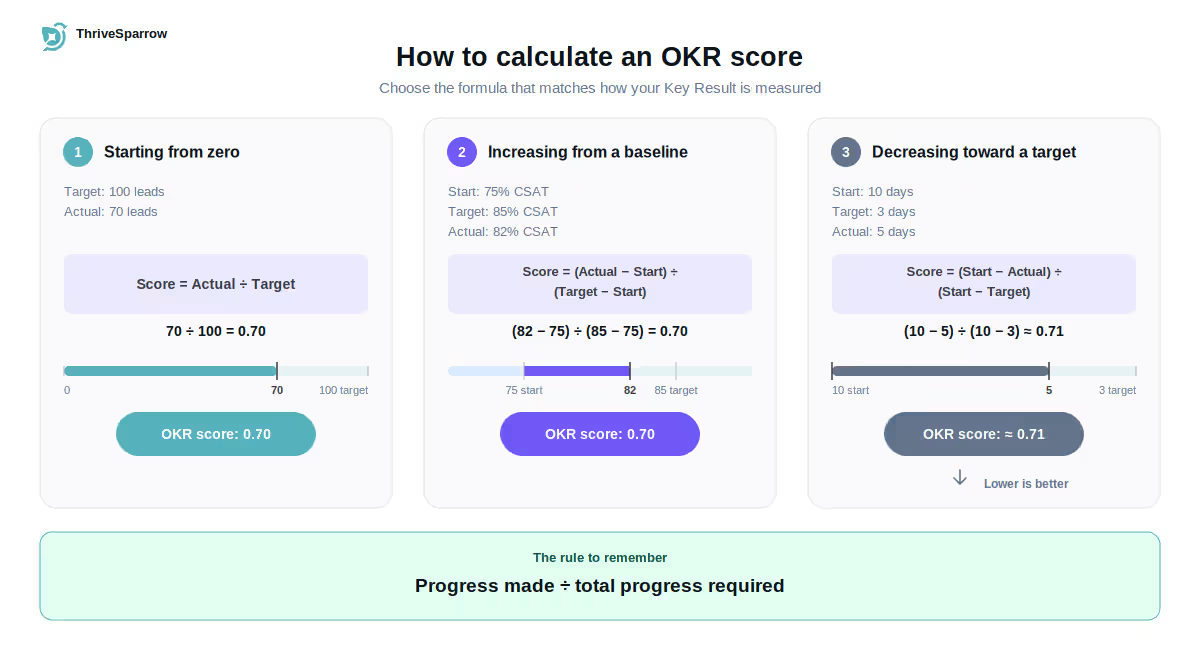
For a straightforward target with a zero baseline, the formula is simple:
Score = Actual ÷ Target
Target: 100 new leads. Actual: 70 leads. Score = 70 ÷ 100 = 0.7.
But watch out when your Key Result starts from a non-zero baseline — which is exactly the case with CSAT. If CSAT started at 75% and the target is 85%, and you end the quarter at 82%, you have not scored 82 ÷ 85 (≈0.96). That treats the entire 0–85 range as your progress, when really you only needed to move the needle from 75 to 85. The correct formula measures progress against the required change:
Score = (Actual − Start) ÷ (Target − Start)
So: (82 − 75) ÷ (85 − 75) = 7 ÷ 10 = 0.7.
That distinction matters. Get it wrong, and you'll consistently overstate progress on any KR that didn't start at zero — which is most of them.
In short: always divide the progress you made by the total progress you needed to make — not the raw actual by the raw target. For a zero-baseline KR, those are the same thing; for anything else, they're not.
For Key Results where improvement means a lower number — like reducing bug-fix time from 10 days to 3 — flip the formula around:
Score = (Start − Actual) ÷ (Start − Target)
Using the bug-fix example (start 10, target 3, actual 5): (10 − 5) ÷ (10 − 3) = 5 ÷ 7 ≈ 0.71 (see the Product/Engineering example further down).
If a result ends up exceeding the target, decide upfront whether your scoring system allows scores above 1.0 or caps them at 1.0, then apply that rule consistently across the cycle.
Step 5: Calculate the overall Objective score
Once each Key Result has a score, the Objective's score is typically the average of all of them. Say our three Key Results land at:
- CSAT (75% → 85%): 0.7
- Reduce average response time: 0.8
- Increase self-serve resolution rate: 0.6
Average: (0.7 + 0.8 + 0.6) ÷ 3 = 0.7.
A simple average is the most common approach, and it's a reasonable default. Some teams weight Key Results differently — if one KR is clearly more critical to the Objective than the others, it's fair to give it more weight in the average rather than treating all three as equal. There's no single rule here; just be consistent about whichever approach you pick, cycle over cycle.
Step 6: Interpret the score
A 0.7 isn't a grade — it's a starting point for a conversation. Is 0.7 good? That depends on whether "Improve customer support experience" was a committed goal or a genuine stretch. That's the piece most teams get wrong, and it's exactly what the next section walks through.
Managing OKRs across multiple teams? As the number of Objectives and Key Results grows, keeping progress and scoring consistent can become harder to manage manually. Explore how ThriveSparrow Goals can help teams keep goal progress visible in one place.
What Does Your OKR Score Mean?
A number on its own doesn't tell you much. Here's a general 0–1 OKR scoring scale you can use as a starting reference point:
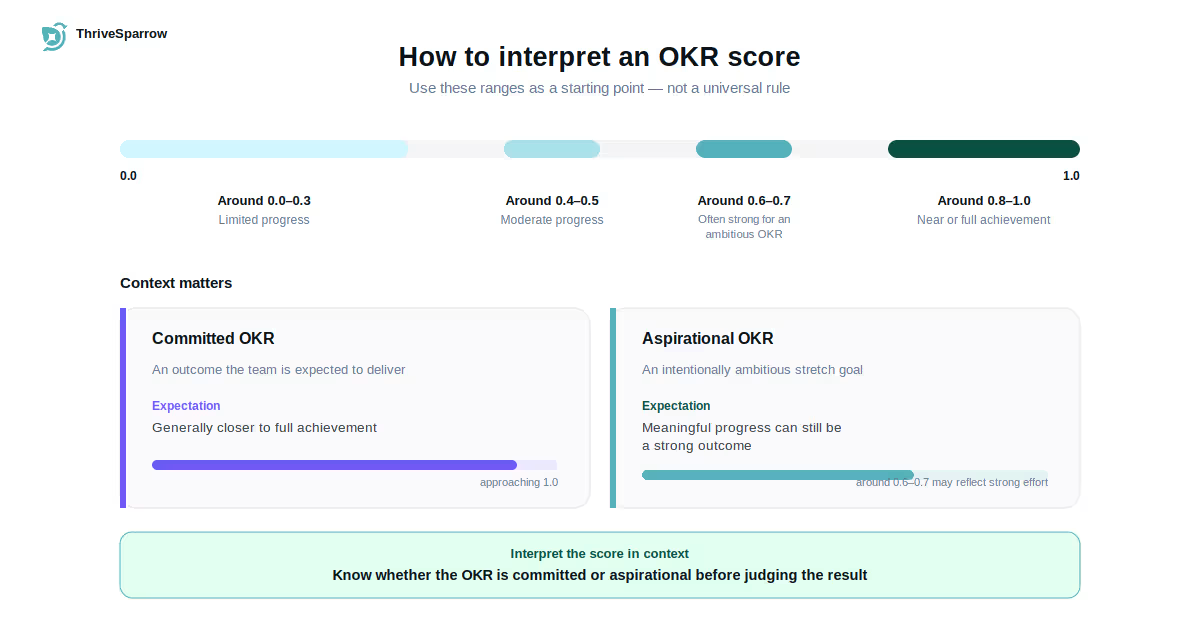
Treat this table as a starting point, not a rulebook. A 0.7 isn't automatically a good score for every OKR — it depends entirely on what kind of OKR you set in the first place. That distinction is the difference between reading a score correctly and misreading it completely.
Committed vs. Aspirational OKRs
Committed OKRs are goals your team is expected to achieve — a product launch, a compliance deadline, a contractual milestone, a board commitment. These are promises. For a committed OKR, you want a score close to 1.0. Landing at 0.6 on a committed OKR generally indicates the intended outcome wasn't fully achieved, and it's worth a closer look at what got in the way.
Aspirational OKRs are intentionally ambitious goals where full achievement may be difficult, sometimes even unlikely. They're designed to push a team past what's comfortable. For these, a 0.6–0.7 is often a genuinely strong outcome — high enough to show real movement, low enough to confirm the goal was actually a stretch rather than a formality.
So, is 0.7 a good OKR score? It depends on the type of OKR and how your organization defines success. On an aspirational OKR, 0.7 is usually something to be pleased with. On a committed OKR, 0.7 means you fell short of something your team promised to deliver. The number is identical; what it means is not — and reading every score the same way is one of the more common ways OKR scoring goes wrong.
The practical fix: label each Objective as committed or aspirational before the cycle starts, not after you see the score. Deciding after the fact invites teams to reframe a miss as "well, it was always a stretch goal."
Common Ways to Score OKRs
There's no single correct scoring system — the right one depends on what the Key Result actually measures. The first three below (0–1, percentage, and binary) are ways to score actual achievement once results are in. Confidence scoring, covered last, serves a different purpose — estimating the likelihood of hitting a Key Result during ongoing check-ins — and works best alongside an achievement score, not in place of one.
0–1 Scoring
Percentage Scoring
Binary Scoring
Confidence Scoring (For Check-Ins, Not Final Scores)
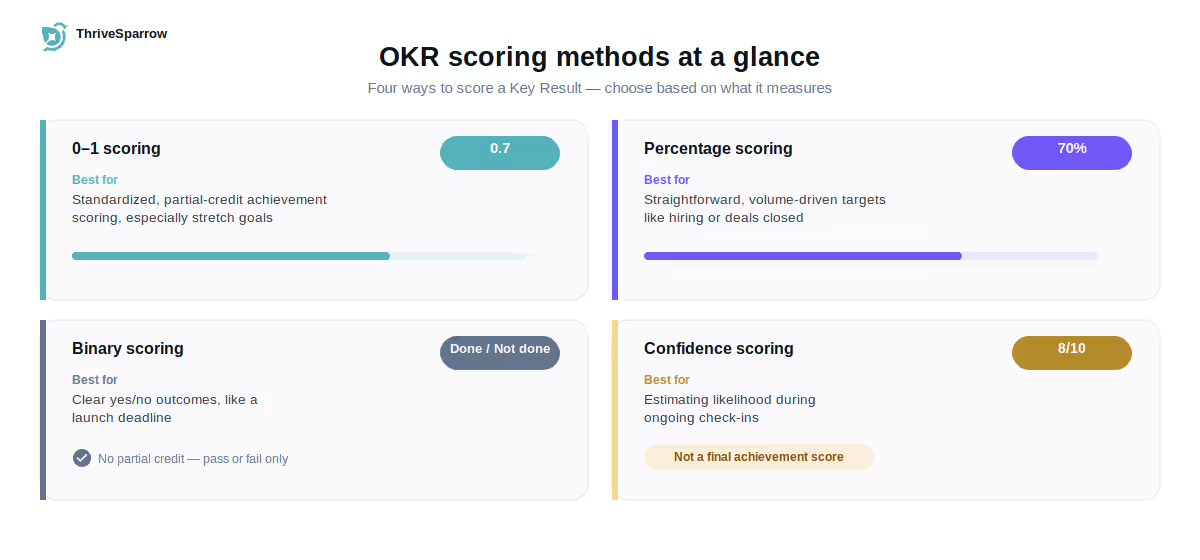
One important clarification: a confidence score is not the same as an achievement score. A team can be 40% complete on a Key Result but 8/10 confident they'll close the gap by the deadline — or the reverse, 80% complete but only 3/10 confident the remaining 20% is achievable because it depends on something outside their control. Conflating the two gives leadership a false read on where things actually stand.
Which OKR Scoring Method Should You Use?
Many teams end up using more than one — binary for launches, percentage for volume targets, 0–1 for stretch goals — as long as the overall cadence and review process stays consistent across the company.
How to Keep OKR Scoring Consistent Across Your Team
Scoring one OKR well is a different problem from scoring OKRs consistently across ten teams. Once you're past a single Objective, here's what keeps scores comparable and trustworthy:
- Agree on the scoring method before the cycle starts. Don't let teams decide retroactively — that's when scores start bending to match whatever outcome already happened.
- Make every Key Result measurable. If a KR can't be scored objectively, fix the KR, not the scoring system.
- Set regular check-ins, not just an end-of-cycle review. Reviewing progress often weekly or biweekly, depending on your team's cadence, catches problems early enough to actually act on them.
- Label each Objective as committed or aspirational upfront. This is what makes scores comparable across teams — a 0.9 on a committed goal and a 0.9 on an aspirational one mean different things, and everyone should know which is which going in.
- Use consistent scoring rules within a method. If two teams both use the 0–1 scale, they should be calculating it the same way (see the non-zero baseline nuance above) — not eyeballing it differently.
- Record the context behind unexpected results. A score alone doesn't explain why a team paused feature work to fix a security issue instead of shipping on schedule. A short note does.
- Discuss results as a team, not just report the number. The real value of scoring shows up in the conversation it starts, not in the number itself. For teams doing a full end-of-cycle retrospective, our OKR review guide covers how to structure that conversation.
With the mechanics and ground rules in place, here's what that looks like across a few different functions.
OKR Scoring Examples
Here's how the same scoring logic plays out across different functions. In each case, the score alone isn't the point — what it tells you is. (For more OKR examples beyond scoring specifically, see our full OKR examples guide.)
Marketing
- Objective: Grow brand visibility
- Key Result: Increase website traffic from 30,000 to 50,000 monthly visitors
- Actual: 42,000
- Calculation: (42,000 − 30,000) ÷ (50,000 − 30,000) = 0.6
- What it tells you: Meaningful growth, but the campaign didn't fully close the gap — worth checking whether the channel mix or budget needs adjusting next cycle. For more function-specific examples, see our marketing OKR examples.
Sales
- Objective: Expand enterprise revenue
- Key Result: Close $2M in new enterprise deals
- Actual: $1.5M
- Calculation: $1.5M ÷ $2M = 0.75
- What it tells you: Strong quarter relative to target, but worth checking whether $2M was set as a stretch or a committed number — that changes whether 0.75 is a win or a shortfall. See OKRs for sales teams for more.
HR
- Objective: Boost employee engagement
- Key Result: Raise eNPS from 20 to 40
- Actual: 35
- Calculation: (35 − 20) ÷ (40 − 20) = 0.75
- What it tells you: Real, measurable improvement in sentiment — a good candidate to dig into which specific initiative (recognition, pay transparency, manager training) drove the gain. Our HR OKRs guide has more examples specific to people teams.
Product/Engineering
- Objective: Improve product reliability
- Key Result: Reduce average bug-fix time from 10 days to 3 days
- Actual: 5 days
- Calculation: (10 − 5) ÷ (10 − 3) = 0.71 (progress made ÷ progress needed, since the target here is a lower number)
- What it tells you: Solid progress, though not full achievement — the team should look at whether the remaining gap is a process issue or a staffing one. More examples in our OKRs for product managers guide.
Common OKR Scoring Mistakes
- Treating 0.7 as universally successful. As covered above, 0.7 is only a "good" score for aspirational goals — not committed ones. Always check which type of OKR you're scoring before judging the number.
- Writing Key Results that can't be measured. "Improve collaboration" can't be scored. If you can't put a number on it, fix the KR before you try to score it.
- Confusing outputs with outcomes. "Publish 20 blog posts" is an output. "Grow organic traffic by 30%" is an outcome. Scoring outputs can make a team look productive while missing whether any of it actually mattered.
- Changing scoring criteria halfway through the cycle. Switching from percentage to 0–1 scoring — or quietly redefining what "target" means — mid-quarter makes the final score meaningless as a comparison point.
- Waiting until quarter-end to check progress. By the time you sit down to score, you should already know roughly where you'll land. If the score is a surprise, you weren't tracking it.
- Confusing confidence scores with achievement scores. A team can be 8/10 confident and only 40% complete at the same time. Reporting one as if it were the other misleads leadership about where things actually stand.
- Using OKR scores directly as employee performance ratings. The moment a score affects someone's bonus or review, people start setting safer, easier goals — which defeats the point of aspirational OKRs entirely.
OKR Scoring Best Practices
A few things worth adding, beyond what's already covered above:
- Watch for vanity metrics. A Key Result can look great on paper — "10,000 free trial sign-ups" — and still miss the point if only 2% convert to paying customers. Score the metric that reflects real impact, not the one that looks best in a review.
- Don't compare scores calculated with inconsistent rules. A 0.8 on the 0–1 scale and 80% on a percentage-based KR aren't automatically the same result — check how each was actually calculated before treating them as comparable.
Tools for Scoring and Managing OKRs
Scoring a handful of OKRs manually is relatively straightforward. The challenge comes when multiple teams are updating dozens or hundreds of Key Results, using different scoring methods, and trying to keep progress visible across the organization. Here's how the common options compare:
None of these is a wrong choice on its own — it depends on how many teams are scoring OKRs, how connected you need goal management to be with your existing workflows, and the level of visibility and coordination your organization needs. (If you're comparing specific vendors rather than categories, our best OKR software roundup breaks those down individually.)
If reconciling spreadsheet versions every quarter sounds familiar, here's what a centralized alternative actually looks like in practice.
Simplify OKR Management With ThriveSparrow Goals
If you've felt the gap between "we have a scoring framework" and "we can actually see where every team stands," here's where that usually comes from — and how ThriveSparrow Goals addresses it directly.
The challenge: Progress updates live scattered across spreadsheets, Slack threads, and individual trackers, each updated at a different time by a different person.
The outcome you want: One place to see real, current goal progress — without chasing anyone down for a status update.
How ThriveSparrow helps: ThriveSparrow Goals is built to let teams track Key Result progress in one shared place instead of across separate spreadsheets.
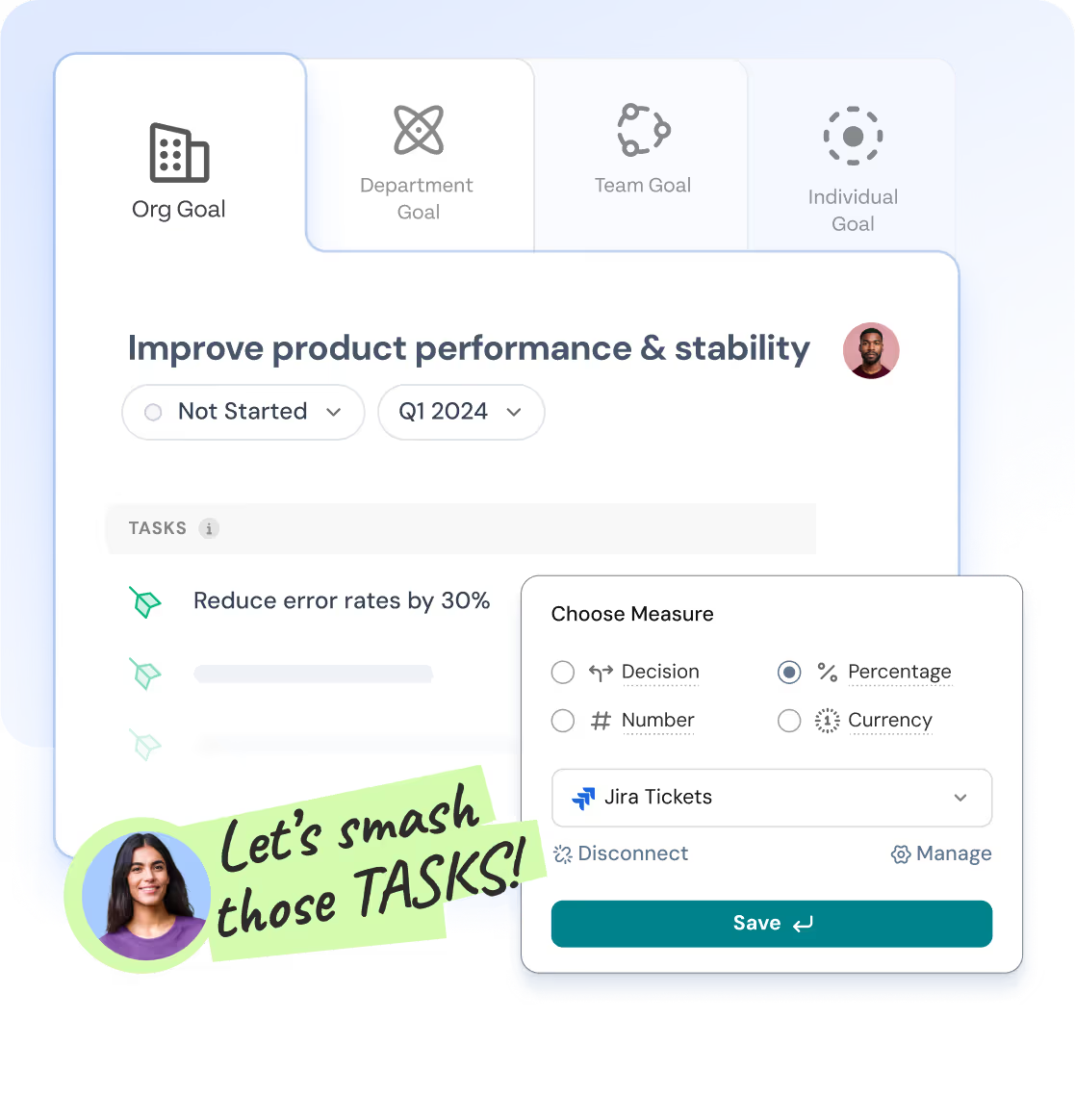
The challenge: Individual and team goals exist, but nobody can easily see how they connect to what the company is actually trying to achieve.
The outcome you want: Clear alignment — every OKR visibly rolling up into the goal above it.
If manual tracking is starting to cost your team more time than it saves, it's worth seeing what a centralized system looks like in practice. Try ThriveSparrow Goals →
.svg)
Frequently Asked Questions
1. How do you score an OKR?
Score each Key Result using a consistent method — 0–1 scale, percentage, or binary — based on how close the actual result came to the target. Then average the Key Result scores to get the Objective's overall score.
2. What is a good OKR score?
There's no single universal number — it depends on whether the OKR is committed or aspirational. For a committed OKR — something the team is expected to deliver — the expectation is generally to finish close to full achievement. For an aspirational, stretch-style OKR, 0.6–0.7 is often considered a solid outcome, since it shows real progress on a genuinely hard goal. Scoring 1.0 on a stretch goal, or well under that on a committed one, is usually worth a closer look at what that says about how the goal was set.
3. Is 0.7 a good OKR score?
Usually yes for an aspirational, stretch-style goal. Usually no for a committed goal your team promised to deliver. The number alone doesn't tell you which — the goal type does.
4. How often should OKRs be scored?
A final score is typically calculated at the end of your OKR cycle, which many teams run quarterly. But don't wait until then to review progress. Regular check-ins — often weekly or biweekly, depending on your team's cadence — can help surface problems while there's still time to respond.
5. What's the difference between OKR scoring and OKR grading?
Generally none — the terms are used interchangeably. "Grading" echoes the 0.0–1.0 scale commonly associated with Google's OKR practice; "scoring" is the more common umbrella term across all methods.
6. Should committed and aspirational OKRs be scored differently?
Not in mechanism — both use the same scoring methods. But they should be interpreted differently. A near-1.0 score is the goal for committed OKRs; a 0.6–0.7 is often a strong outcome for aspirational ones.