








Collecting employee feedback across 20 countries sounds straightforward. It isn't. For Dyninno's HR team, every feedback cycle played out the same way. Download responses from scattered Microsoft Forms. Copy data into spreadsheets. Spend days manually consolidating everything into a report. Send reminders to teams that hadn't responded. Follow up again when those reminders got ignored. By the time the final report reached leadership, the data was already old. Decisions that should have taken hours took weeks. And the cycle would start all over again.
A feedback process that takes five days just to produce a report isn't really serving anyone. It's paperwork disguised as listening. The HR team knew something was off. They were spending more energy managing the process than actually understanding what employees were saying.
Many organizations face similar challenges when managing employee feedback—collecting surveys across multiple teams, locations, and business units without a centralized system. So here’s an easy solution: our employee feedback survey template, which is helping companies with 3,000+ employees worldwide.
About Dyninno
Dyninno is a global technology group with businesses across travel, finance, and entertainment technologies. The company operates in 20 countries with more than 5,000 employees spread across different cultures, languages, time zones, and business units.
At that scale, you can't afford blind spots in how you understand your workforce. But that's exactly what fragmented feedback creates — pockets of insight here and there, with no unified picture of what's actually happening across the organization. Building a structured voice of employee program helps organizations gather consistent insights and create a clearer understanding of workforce sentiment.
What Went Wrong With Microsoft Forms
Before ThriveSparrow, Dyninno ran all employee surveys through Microsoft Forms. For a while, it was good enough. But "good enough" stops working when you scale past a certain point.
1. Responses were scattered across dozens of forms.
There was no central place where HR could see feedback from all 20 countries in one view. Every time a leader asked "what are employees telling us?" the answer required days of manual work just to assemble. As organizations scale, employee surveys become difficult to manage when feedback data is spread across multiple tools and disconnected reporting systems. Lydia, Dyninno's HR Project Manager, and her team lived inside this cycle. Pull data from one form. Cross-reference it with another. Copy numbers into a master spreadsheet. Format it for leadership. Do it again next month.
2. Each cycle consumed two to five days.
Not two to five days of analysis. Two to five days of data entry, formatting, and consolidation before analysis could even begin. Some months, the team spent more time building the report than reading what employees actually said. Modern feedback analytics tools help HR teams spend less time compiling reports and more time identifying workforce trends and improvement opportunities.
3. Participation varied wildly across regions.
Some offices responded well. Others barely participated. The problem wasn't that employees didn't care. The problem was access. Not everyone had a corporate email. Not everyone sat at a desk. Not everyone could easily find and open a survey link buried in their inbox between fifty other messages.
When participation is low, most organizations assume employees aren't engaged. In reality, improving survey participation often depends on reducing access barriers and making feedback easier for employees to share. More often, the real issue is that the survey never reached them in a way that was easy to respond to.
4. Leadership couldn't see anything in real time.
The data existed — locked inside spreadsheets that took days to assemble. Leaders who needed quick insight into workforce sentiment had to wait for the HR team to finish manual compilation. By then, the window to act on emerging issues had often closed.
5. Nothing about the process could scale.
Every new office, every new business unit, every new country meant another layer of manual complexity. The team was already stretched. Adding more surveys, more regions, more employees to the same spreadsheet-based workflow wasn't going to work.
The Turning Point
Dyninno was growing fast. New markets. New teams. New business units across multiple continents. The organization was scaling — but the feedback infrastructure wasn't scaling with it.
HR was still manually stitching together insights from fragmented forms. Leadership still waited days for reports. Participation was still inconsistent across regions. And the team was running out of capacity to keep the process going.
The team looked at several employee feedback platforms. Many were built for large enterprises with dedicated people analytics teams — powerful tools with deep customization, but also complex implementations that took months to configure and required specialized resources to maintain.
Dyninno needed something different. A platform their existing HR team could set up quickly, manage independently, and scale across 20 countries without adding headcount or technical overhead.
That's a harder requirement to meet than it sounds. Most platforms are either too simple to handle global complexity or too complex to deploy without a dedicated implementation team.
Why ThriveSparrow Fit
ThriveSparrow landed in the middle of that gap.
It was sophisticated enough to run standardized surveys across a 5,000-person global organization. But simple enough that the HR team could set it up, configure it, and manage it without external help.
1. One platform replaced seven scattered forms.
All of Dyninno's global surveys were consolidated within ThriveSparrow. One source of truth. One reporting structure. One dashboard where HR could see feedback from every country, every business unit, every team — without manually pulling data from different tools.
The immediate effect was clarity. For the first time, the organization had a unified view of what employees were saying across the entire company.
2. QR code surveys changed who could participate.
This is where ThriveSparrow's approach made the biggest practical difference — and where it separated itself from most other employee feedback platforms.
Most survey tools distribute through email. That works for office-based teams sitting at computers. It doesn't work for employees in distributed offices who may not check email regularly, don't have corporate accounts, or simply miss the survey link in a crowded inbox.
Dyninno printed QR codes and displayed them across offices in all 20 countries. Common areas. Break rooms. Notice boards. Employees scanned with their phones and completed the survey in minutes. No login required. No app to download. No corporate email needed.
The participation impact was immediate. People who had never completed a company survey before were suddenly responding — because for the first time, responding was genuinely easy.
For a workforce spread across 20 countries with diverse roles and work environments, QR code access wasn't a convenience feature. It was the infrastructure that made global participation possible.
3. Automated dashboards eliminated manual reporting.
Scheduled weekly reports were delivered to stakeholders automatically. No more two-to-five-day spreadsheet marathons. No more formatting decks for leadership reviews. The data was always current, always accessible, always consistent. The HR team went from spending most of their time building reports to spending most of their time reading them. Real-time HR analytics give leaders instant access to workforce insights without waiting for manual reporting cycles.
4. Jira integration connected feedback to existing workflows.
Dyninno's teams already used Jira Service Desk. ThriveSparrow connected directly to it. Employee feedback submitted through Jira was recorded in ThriveSparrow automatically. No manual transfer. No double handling. No feedback falling through the cracks between systems. Small integrations like this matter more than they seem. Connecting employee feedback workflows with existing business systems reduces manual effort and improves response management. Every manual handoff between tools is a place where data gets lost or delayed.
5. Setup took days, not months.
New surveys, updated questions, adjusted workflows — the team handled all of it in one to two days. No engineering tickets. No external consultants. No waiting.
When you're operating across 20 countries, things change frequently. A new market launches. A business unit restructures. A regional team needs a different question set. The ability to adapt quickly without technical dependencies is what makes a platform sustainable long-term.
How Implementation Worked
Dyninno's rollout was deliberate and practical.
1. Phase one: Consolidation.
The HR team migrated all seven global surveys into ThriveSparrow. This created immediate standardization — the same survey framework, the same data structure, the same reporting format across every region.
2. Phase two: Distribution.
QR codes went up across offices globally. Surveys were also shared through Microsoft Teams and internal portals. The goal was to meet employees wherever they were — on their phones, on their desktops, on their internal communication tools.
3. Phase three: Automation.
Weekly reports were configured for key stakeholders. Jira integration was activated. The manual processes that had consumed the HR team's time were systematically replaced with automated workflows.
Not every region adopted at the same pace. Some offices started responding within the first week. Others took longer. That's expected in any global rollout. But because the access barriers were low — scan a code, answer a few questions — participation built steadily without requiring the kind of constant reminders that had defined the old process.
4. The deeper shift happened after the logistics were solved.
Once the HR team wasn't spending days on manual reporting, they could focus on what the data actually said. They started identifying patterns across regions. Flagging emerging concerns before they escalated. Working with leadership on targeted action plans based on real-time employee sentiment.
ThriveSparrow didn't just make feedback collection faster. It gave the HR team the capacity to actually do something with the feedback they collected.
The Results: What Actually Changed
1. 70% Less Manual Work
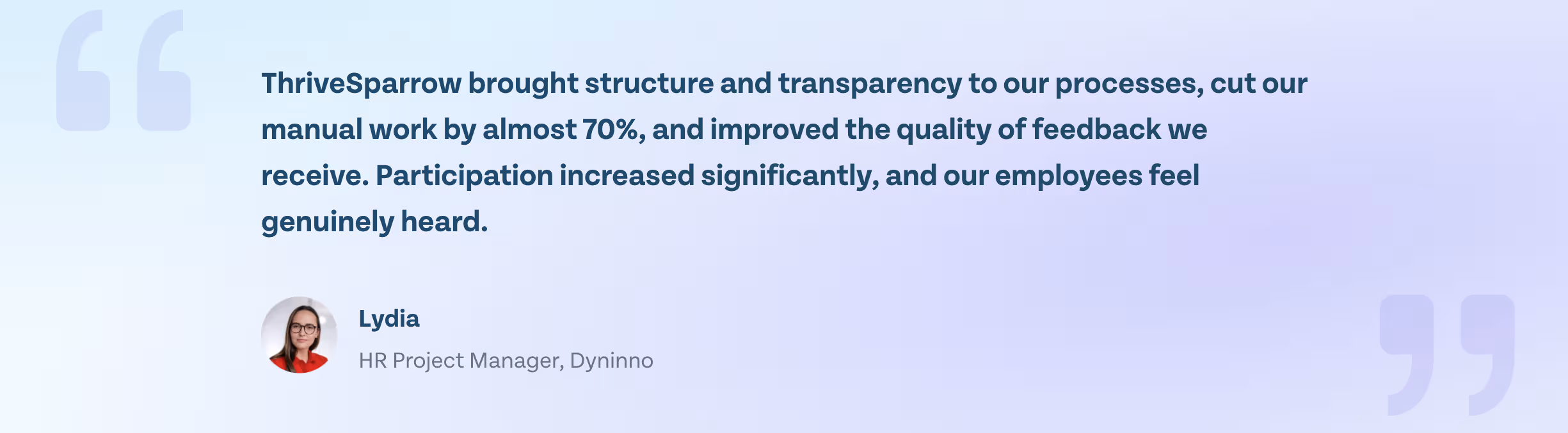
What previously took two to five days now takes one to two business days. No spreadsheets. No manual consolidation. No repetitive formatting. The HR team's time shifted from building reports to understanding them. That's not just an efficiency gain. It's a fundamentally different way of operating.
2. eNPS Doubled Across Business Units
NPS scores moved from 3.9 to 5 in some units. From 5 to 10 in others. In employee engagement measurement, movements like this don't happen because of a new tool alone. They happen when employees start believing their feedback actually matters. When the gap between "we collected your input" and "here's what we're doing about it" gets shorter, trust builds. And trust drives eNPS. Dyninno's team made that connection visible — and the scores reflected it.
3. 3,000+ Responses Across a Global Workforce
Getting 3,000+ survey responses from 5,000 employees spread across 20 countries is a strong participation rate by any standard. QR code access was the biggest driver. Employees who had never completed a feedback survey before — because previous methods never reached them effectively — were now participating for the first time. When you solve the access problem, you find out that most employees actually want to share their perspective. They just need a way to do it that fits into their day.
4. Employees Feel Heard
This is harder to quantify but equally important. Sentiment improved across the organization as employees saw their feedback leading to real changes. Not just reports that disappeared into a folder. Actual follow-through. The fastest way to kill survey participation is to collect feedback and visibly do nothing with it. Dyninno's team understood this and made the feedback-to-action loop transparent.
5. Leadership Gained Real-Time Visibility
Instead of waiting days for manually compiled reports, leadership could now see workforce trends as they emerged. Department-level concerns. Regional patterns. Sentiment shifts across business units. This changed the speed at which the organization could respond to employee needs — from reactive and delayed to proactive and informed.
What Other HR Teams Can Learn
1. Consolidation changes everything.
If your employee feedback lives across multiple tools and forms, you're spending more time managing data than learning from it. One platform, one source of truth, one reporting structure. The operational simplification alone is worth the switch.
2. Access determines participation.
QR code surveys sound almost too simple to matter. That simplicity is exactly the point. When you remove login barriers, app downloads, and email dependencies, you reach employees that email-based platforms systematically miss. This matters most for distributed and deskless workforces.
3. Automate reporting from day one.
Manual report building doesn't just waste HR time. It delays organizational decisions. Stakeholders should get insights automatically and on schedule — not whenever someone finishes a spreadsheet.
4. Connect your tools.
Dyninno's Jira integration meant feedback captured in one system automatically appeared in the other. Every manual handoff between tools is a place where data gets delayed or lost. Small integrations prevent that.
5. Adoption won't be uniform.
Some regions will embrace new tools immediately. Others will take time. That's normal. Design for low friction and let participation build organically rather than forcing it through constant reminders.
6. Close the loop visibly.
Employees notice when their feedback leads to change. They also notice when it doesn't. If you want sustained participation, make the connection between input and action obvious. Share what you learned. Share what you're doing about it.
7. Don't over-engineer the platform choice.
Not every organization needs the most complex enterprise feedback suite on the market. If you're a fast-growing company that needs to go live across multiple countries quickly, operational simplicity and speed of deployment often matter more than features you won't use for another two years.
The Bigger Picture
Dyninno didn't just replace Microsoft Forms with a better survey tool. They built the foundation for a feedback-driven culture across 20 countries and 5,000 employees. One where feedback is collected consistently, reported automatically, and acted on visibly.
The real transformation wasn't faster reporting or higher participation — though both happened significantly. It was the shift in what the HR team could spend their time on. Instead of managing spreadsheets and chasing responses, they could focus on understanding employee sentiment, identifying emerging concerns, and working with leadership to make the organization better.
That's the difference between a survey tool and an employee success platform. One collects data. The other helps you build an organization that actually listens.
Running employee feedback across a global workforce shouldn't consume your HR team's entire week. ThriveSparrow helps organizations centralize surveys, automate reporting, and make feedback accessible to every employee — no matter where they work or how they work.
Explore ThriveSparrow Feedback→ Try it Free for 14 days!
.svg)