










The Balanced Scorecard and OKRs are both strategic management frameworks, but they solve different problems.
- The Balanced Scorecard maps long-term strategy across four perspectives financial, customer, internal process, and learning & growth and is typically reviewed annually or quarterly by leadership.
- OKRs (Objectives and Key Results) break strategy into a small number of ambitious, measurable goals set every quarter and checked in on weekly. Most fast-moving teams use OKRs to execute, and some borrow the Balanced Scorecard's structure to keep long-range strategy organized.
Neither one replaces the other, they operate at different altitudes. Here's how they actually compare, when each one fits, and how some organizations use both at once.
At a glance: Balanced Scorecard vs OKR
What is a Balanced Scorecard?
A Balanced Scorecard (BSC) is a strategic planning and management framework developed by Robert Kaplan and David Norton in the early 1990s, first published in the Harvard Business Review.
It was built as a response to a real problem: companies were managing themselves almost entirely on financial results, which show you what already happened but say nothing about what's about to happen.
The Balanced Scorecard organizes strategy into four perspectives:
- Financial the lagging outcomes: revenue growth, profitability, cost efficiency.
- Customer how customers actually experience the business: satisfaction, retention, market share.
- Internal Process the operational engine: quality, cycle time, productivity, the processes that need to work well for the first two to happen.
- Learning & Growth the leading indicators: employee skills, culture, systems, and capacity for innovation that make future performance possible.
For each perspective, the organization sets objectives, metrics, targets, and initiatives and maps the cause-and-effect relationships between them (this is often visualized as a "strategy map").
The idea is that improvements in Learning & Growth drive better Internal Processes, which drive a better Customer experience, which eventually shows up in Financial results. It's a way of making sure leadership isn't just staring at last quarter's revenue number and hoping it improves.
BSC is still widely used in large enterprises, government bodies, and nonprofits anywhere strategy needs to be communicated and tracked across a big organization over a long time horizon.
What is OKR?
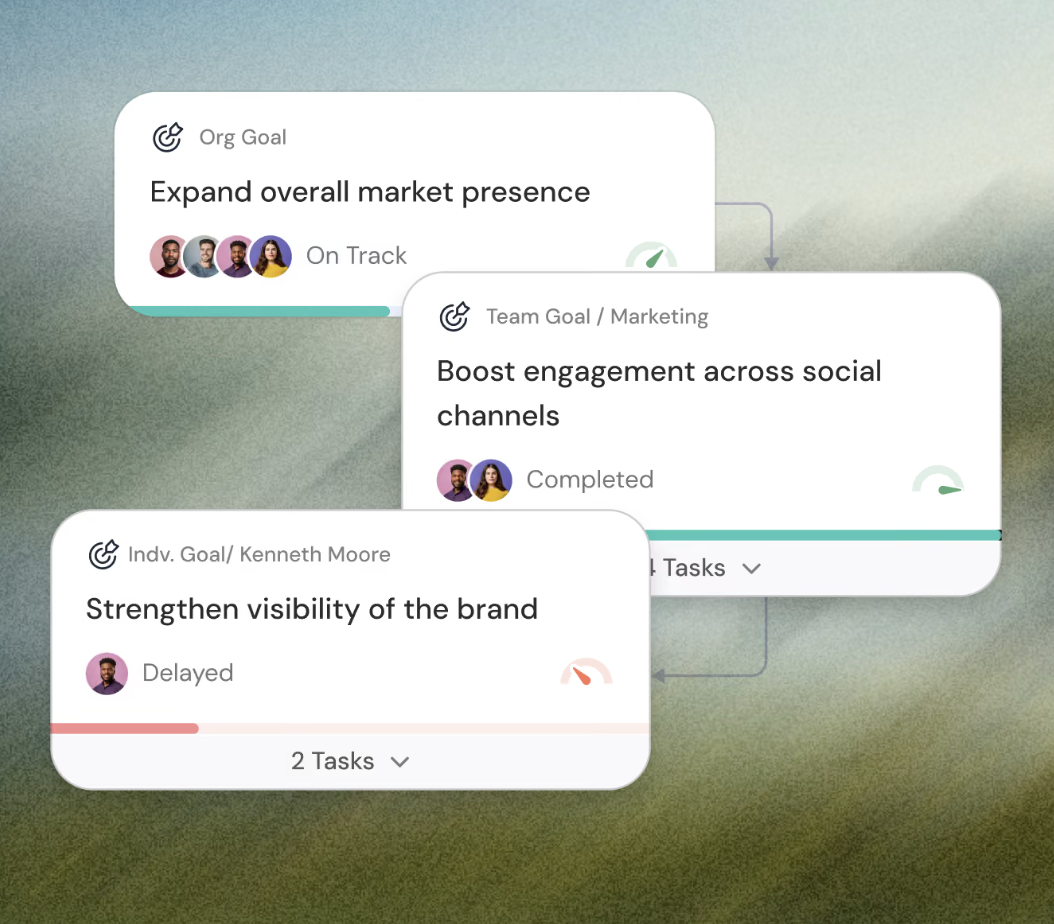
OKR stands for Objectives and Key Results. It's a goal-setting framework where each Objective is a qualitative, ambitious statement of what you want to achieve, paired with 2–5 Key Results that are specific, measurable, and time-bound.
The format is often summarized as:
I will [Objective] as measured by [this set of Key Results].
OKRs originated at Intel under Andy Grove in the 1970s and were documented in his book High Output Management. John Doerr, an early Google investor who had worked at Intel, brought the framework to Google in 1999 and later wrote Measure What Matters (2018), which is largely responsible for OKRs becoming the default goal-setting language across tech companies and startups worldwide.
A few things distinguish OKRs from most other goal frameworks:
- Short cycles. OKRs are usually set quarterly, not annually, which forces regular reprioritization.
- Stretch goals. Many teams deliberately set Objectives that are hard to fully achieve hitting 70–80% of an ambitious Key Result is often considered a win, because it means the bar was set high enough to matter.
- Transparency. OKRs are typically visible across the whole company, so anyone can see what any team or individual is working toward and why.
- Separation from performance reviews. In their original form, OKRs are meant to measure progress on goals, not to be a direct input into compensation or ratings though in practice many companies blend the two.
If you want the mechanics of writing and grading your own OKRs, what OKRs are and how to write them and how to score and grade OKRs cover that in more depth.
Want to set and track OKRs without the spreadsheet chaos? Try ThriveSparrow free and get your team's goals aligned in minutes.
Balanced Scorecard vs OKR: the key differences
1. Scope and altitude. BSC operates at the level of overall organizational strategy, it's asking "is our strategy working, across every dimension of the business?" OKRs operate at the level of execution, they're asking "what are the handful of things we need to nail this quarter to move that strategy forward?"
2. Time horizon. BSC is built for multi-year thinking, even if it's reviewed quarterly. OKRs are built for quarters, sometimes months. A BSC objective might stay on the scorecard for years; an OKR is expected to change every cycle.
3. Rigidity vs. flexibility. The Balanced Scorecard's four-perspective structure is fixed by design, that consistency is what makes it useful for tracking strategy over time and comparing performance across business units. OKRs have almost no fixed structure beyond "Objective + Key Results," which makes them easy to adapt but easier to do badly without discipline.
4. Ownership and direction. BSC is typically designed top-down by leadership and finance, then cascaded. OKRs are often set with real input from the teams doing the work company-level OKRs cascade down, but team and individual OKRs are frequently written bottom-up and then aligned upward.
5. Measurement philosophy. BSC targets are usually meant to be hit, they're tied to budgets, forecasts, and accountability. OKR Key Results are often meant to be stretched toward ambitious by design, with partial achievement treated as informative rather than a failure.
6. What "done" looks like. A Balanced Scorecard is never really finished, it's a permanent management system. An OKR cycle has a clear endpoint: you score it, reflect, and write new ones.
7. Best-fit organization. BSC tends to suit larger, more established organizations, especially ones in regulated or slower-moving industries that need a durable way to track strategy across many business units over years. OKRs tend to suit startups, scale-ups, and any team that needs to move fast and refocus often.
What Balanced Scorecard and OKR have in common
Despite the differences, both frameworks exist to solve the same underlying problem: the gap between strategy and execution. Specifically, they both:
- Force an organization to define what actually matters, instead of tracking everything
- Connect day-to-day work back to a bigger strategic goal
- Rely on regular, structured review cadences rather than "set it and forget it" planning
- Combine qualitative direction with quantitative measurement
- Work better with software than with static spreadsheets, once more than a handful of people are involved
Neither framework is inherently "better", they were built for different problems, at different points in strategic management history, and plenty of organizations that use OKRs well still borrow BSC-style thinking about balancing financial and non-financial measures.
Can you use Balanced Scorecard and OKR together?
Yes, and quite a few organizations do. A common hybrid model looks like this:
- Balanced Scorecard sets the map. Leadership uses the four perspectives to define the long-term strategic themes and objectives — what needs to be true financially, for customers, in internal processes, and in organizational capability over the next few years.
- OKRs become the execution engine. Each quarter, teams translate the relevant piece of the BSC into a specific Objective with measurable Key Results. The Balanced Scorecard answers "what does winning look like over the next 3 years?" and OKRs answer "what does winning look like this quarter, given that?"
This isn't a workaround, the Balanced Scorecard Institute itself has published guidance on using OKRs with a Balanced Scorecard rather than instead of one. If your organization already has a working BSC and feels like execution is where things stall, layering OKRs on top of the existing strategic themes is usually a lighter lift than replacing the whole system.
Balanced Scorecard vs KPI vs OKR
This trio gets confused constantly, mostly because a KPI can technically live inside either of the other two frameworks.
- KPI (Key Performance Indicator) isn't a framework at all it's a single metric. "Customer churn rate" or "employee eNPS" is a KPI.
- Balanced Scorecard is a framework for organizing KPIs into four strategic perspectives, so you're not just tracking metrics in isolation.
- OKR is a framework where Key Results function like time-bound, stretch-oriented KPIs attached to a specific, ambitious Objective.
In short: a KPI tells you what to measure. BSC and OKR are two different ways of deciding which KPIs matter right now and organizing them into something you can actually act on.
Balanced Scorecard example vs OKR example
Scenario: a company wants to improve customer retention.
Balanced Scorecard approach (strategic, multi-year, cross-perspective):
OKR approach (execution, this quarter):
Notice the relationship: the OKR above is essentially a quarterly, action-oriented slice of the BSC's Internal Process and Customer perspectives. That's the hybrid model in miniature.
How to choose the right framework for your team
- Choose Balanced Scorecard if: you're a large or established organization, you operate in a slower-moving or regulated industry, you need to track strategy consistently across many business units, or your primary need is long-range strategic visibility for a board or leadership team.
- Choose OKR if: you're a startup or scale-up, your priorities shift quickly, you want cross-functional alignment without heavy process, or your biggest problem right now is execution and focus rather than strategic clarity.
- Choose both if: you already have a working strategic plan but execution keeps stalling use your existing strategy (BSC-style or otherwise) to set the direction, and OKRs to drive quarterly focus.
- Whichever you pick, the framework matters less than the habit. Both fail the same way: set once, reviewed rarely, disconnected from what people actually do day to day. A lighter framework used consistently will always outperform a "perfect" one used sporadically.
If your team is choosing OKRs (or a BSC-to-OKR hybrid), OKRs for employee engagement is a useful next read for connecting goal-setting to how engaged your teams actually are while working toward it.
Whichever framework fits your team, tracking it in spreadsheets is usually where things break down objectives go stale, nobody remembers to update key results, and by the time leadership reviews progress it's already out of date. ThriveSparrow's Goals module lets you set and cascade OKRs, tie them into performance reviews, and see how goal progress connects to engagement all in one place.
FAQs
1. Is the Balanced Scorecard outdated?
No, but it has evolved. Large enterprises, governments, and nonprofits still use it for long-range strategic management. The main criticism isn't that it's obsolete, it's that a BSC alone can feel too rigid or slow for teams that need to move quickly, which is exactly why many organizations now pair it with a lighter execution layer like OKRs.
2. Are OKRs still relevant?
Yes. OKRs remain the default goal-setting framework across most tech companies and a growing number of non-tech organizations. Where OKRs fail, it's almost always an execution problem, too many Objectives, no real review cadence, OKRs tied too tightly to performance ratings rather than a flaw in the framework itself.
3. What are the four perspectives of the Balanced Scorecard?
Financial, Customer, Internal Business Process, and Learning & Growth. Objectives, measures, and targets are set within each perspective, and they're mapped to show how progress in one area (like Learning & Growth) is expected to drive results in another (like Financial performance).
4. What's the difference between OKRs and KPIs?
A KPI is a single ongoing metric you track over time (like monthly churn rate). An OKR is a time-bound goal made up of an Objective and several Key Results, and those Key Results often use KPI-style metrics but attach a specific target and deadline to them.
5. Can a small business or startup use a Balanced Scorecard?
It's possible, but most small teams find OKRs a better fit because they're lighter-weight and easier to set up without a dedicated strategy function. BSC tends to add the most value once an organization has multiple business units or departments that need a consistent way to report strategic progress upward.