










Most teams don't struggle with setting goals — it's keeping them alive that's hard.
Quarterly OKRs start strong, then get buried in spreadsheets, scattered across tools, or quietly sidelined by urgent work until leadership asks "how are we doing?" and nobody has a clean answer. That's what OKR software solves: a central place where goals stay visible and updated, so status isn't a guess.
Some platforms are dedicated OKR tracking software, built purely around objectives and key results. Others are broader OKR management software that also handles performance reviews and engagement. Below, we compare 15 platforms — with real pricing, honest limitations, and specific recommendations by team size and use case.
Watch this quick video for a fast overview of the best OKR software tools featured below.
Quick Comparison of the Best OKR Software
This table summarizes each tool's best fit, starting price, G2 rating, and key limitation, based on documented pricing, features, and verified G2 data.
Use this to shortlist before reading the full breakdowns.
Editor's Pick: For HR teams wanting OKRs connected to performance and engagement, ThriveSparrow is the strongest published-pricing fit. For enterprise strategy dashboards specifically, WorkBoard or Quantive fit better.
What Is OKR Tracking Software?
OKR tracking software is the specific layer responsible for keeping objectives and key results current after the planning meeting ends — check-ins, progress visualization, reminders, status reports. It's narrower than "OKR software" broadly, which can also include alignment mapping, performance reviews, and engagement.
If your team already knows how to write good OKRs and just needs them to stay current instead of going stale in a slide deck, this is the feature set to weigh most heavily:
- Check-in cadence — weekly or biweekly prompts, not a once-a-quarter status meeting
- Progress visualization — a chart per key result, not just a percentage that updates silently
- Confidence separate from percentage — the ability to flag "on track numerically but I'm worried," which a raw number can't capture
- Automated reminders to whoever owns a stale key result, not a company-wide nag email
- A dashboard that updates itself — if someone manually rebuilds a status slide every Friday, the tool isn't doing its job
Weekdone, ThriveSparrow, and Profit.co put the most weight specifically on this tracking layer rather than treating it as one feature among many.
Types of OKR Software
Not every tool called "OKR software" solves the same problem:
- Dedicated OKR trackers — objectives and key results are the core object. Weekdone, Profit.co.
- HR-suite platforms with an OKR module — goals live alongside performance reviews, engagement, and recognition. ThriveSparrow, Lattice, Leapsome, 15Five, Betterworks.
- Project-management tools with a goals feature — an existing task system extended into lightweight goal tracking. Asana, ClickUp.
- Enterprise strategy-execution platforms — OKRs as one layer of a broader strategy-to-execution system, usually with a services-led rollout. WorkBoard, Quantive.
If you're evaluating "OKR software" against "goal management software" as separate categories: OKR software specifically structures around objectives and key results and cascading alignment. Goal management software is a broader umbrella that can include personal development goals or project milestones with no OKR structure at all.
If you're not sure OKRs are the right framework for your team at all, our best goal-setting software guide covers the wider category. Most tools on this list are OKR-specific; ClickUp and Asana are closer to general goal management with OKR support layered on.
None of the four categories above is objectively best — the right one depends on whether you want goals standalone or connected to something you already run.
How We Evaluated These Tools
Full disclosure: ThriveSparrow is on this list, and we built it. Every tool here, including ours, is evaluated against the same four criteria:
- Pricing transparency — verified against each vendor's live pricing page as of September 16, 2026, not "contact sales" guesses
- Documented feature depth — pulled from each vendor's own product documentation, not marketing copy
- Verified G2 rating and review count — checked individually against G2's live product pages, linked below
- Integration depth — what's actually documented (Slack, Microsoft Teams, HRIS), not implied
15 Best OKR Software in 2026 (Ranked by Use Case)
1. ThriveSparrow
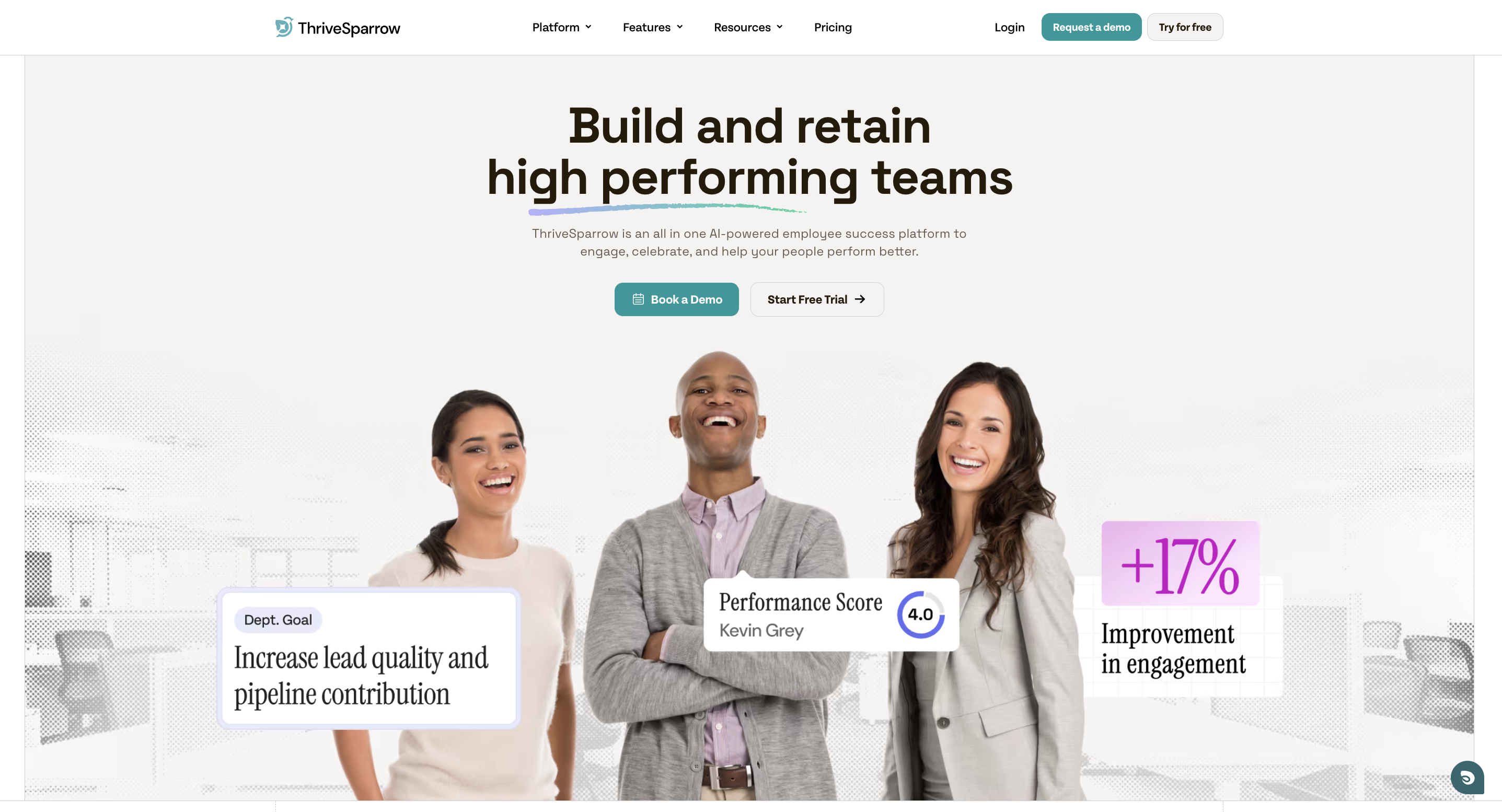
Best for: HR teams that want OKRs connected to performance and engagement
Overview: ThriveSparrow is an employee success platform connecting goal alignment, performance reviews, and engagement surveys. Unlike standalone OKR platforms, it ties goals directly to performance feedback and pulse surveys, so you can see how engagement and performance connect to goal progress in one place.
Key Features:
- Goal alignment and cascading with visual tree views
- Weekly check-ins and automated reminders
- OKRs tied directly to performance reviews and 360 feedback
- AI-powered development plans generated from goal performance
- Native Slack and Microsoft Teams integration
Limitations: Advanced customization and deeper analytics feel limited compared to enterprise-focused platforms like WorkBoard.
Pricing (modular, per employee/month, billed annually):
- Goals (OKRs): $3
- Performance: $5
- Engage: $3
- Kudos: $2
Free trial: 14 days, no credit card required.
G2 rating: 4.3/5 (15 reviews)
Best-Fit Summary: Choose ThriveSparrow if your HR team wants goals connected to reviews, feedback, and engagement instead of sitting in a standalone tracker.
Try ThriveSparrow Goals free for 14 days — see your team's alignment tree before your first check-in cycle ends.
.svg)
2. Lattice

Best for: Enterprise performance management with deep OKR integration
Overview: Lattice brings goal tracking into regular performance conversations, one-on-ones, and development processes. Works best in larger organizations already running formal performance reviews; smaller teams sometimes find it more platform than they need.
Key Features:
- OKR integration with regular meetings and manager tracking
- Wide integrations (Jira, Salesforce, Slack)
- Performance reviews tied directly to goal progress
Limitations: Noticeable learning curve; customization of templates and reports can feel limited.
Pricing: Talent Management (Performance + Goals & OKRs) from $11/seat/month, billed annually. Performance and Goals can be purchased individually from $8/user/month. Add-ons: Engagement ($4), Grow ($4), Compensation ($6), HRIS ($5).
G2 rating: 4.7/5
Best-Fit Summary: Choose Lattice if you need OKRs deeply integrated with performance reviews and compensation planning, and have resources for a full rollout. See ThriveSparrow vs. Lattice for a direct feature-by-feature comparison.
3. Culture Amp

Best for: Engagement-first teams that want goals tied to feedback
Overview: Culture Amp offers flexible goal structures with science-backed guidance for setting measurable objectives. Works best when engagement and feedback are already your priority and you want goals in that same ecosystem, not a separate OKR-only tool.
Key Features: Goal alignment with leadership visibility, science-backed goal-setting guidance, strong survey and engagement reporting.
Limitations: Goal-setting and performance modules are less customizable than dedicated OKR/performance tools.
Pricing: Not disclosed. Custom quote only.
G2 rating: 4.5/5
Best-Fit Summary: Choose Culture Amp if employee engagement is your top priority and you want goal tracking tied to survey insight.
4. Leapsome

Best for: Teams that want OKRs, feedback, and learning in one platform
Overview: Leapsome supports recurring goal cycles with AI-assisted goal creation and integrated feedback requests. Works best for organizations wanting OKRs, feedback, and learning together; trade-off is more upfront configuration than simpler tools.
Key Features: AI Co-Pilot for goal creation, goal ownership and dependency mapping, integrated learning and development tools.
Limitations: UI can feel cluttered for finding specific data; goal updates are more manual; users report notification overload at scale.
Pricing: Not disclosed. Custom quote, with discounts for multi-module purchases.
G2 rating: 4.8/5
Best-Fit Summary: Choose Leapsome if you want OKRs tied to feedback, development plans, and learning in one platform. See ThriveSparrow vs. Leapsome for a closer look at the trade-offs.
5. Profit.co
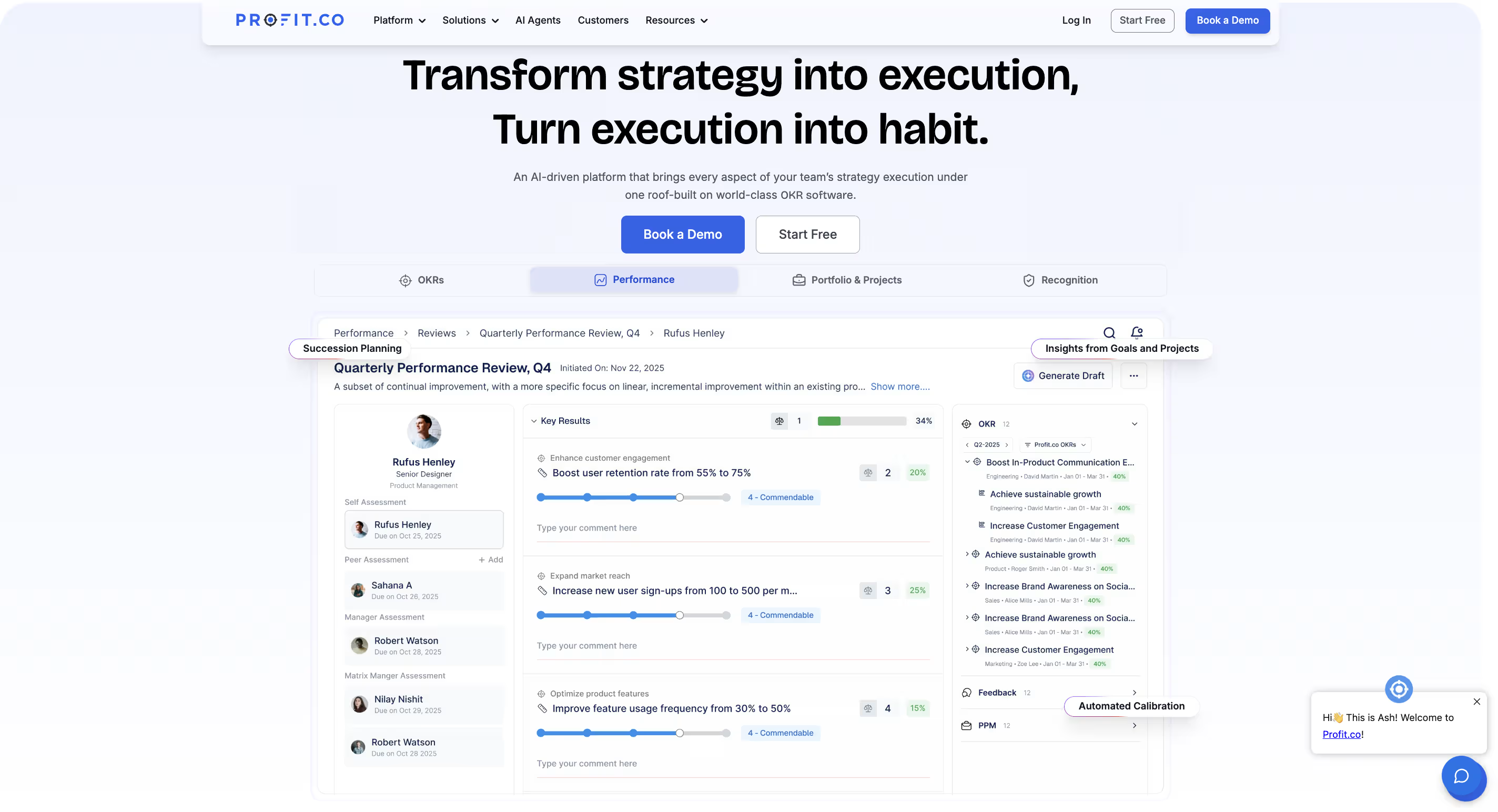
Best for: Teams that want structured OKR templates and AI assistance
Overview: Profit.co's AI-powered templates and alignment dashboards help teams create OKRs quickly, with six key-result types to track measurable and non-measurable outcomes. Better fit for teams wanting structure and rich alignment views than for anyone wanting something minimal.
Key Features: AI-powered OKR creation, real-time dashboards and heatmaps, PowerPoint report generation for stakeholders.
Limitations: Setup takes longer than lighter OKR tools; some reporting export limitations reported.
Pricing: Not publicly listed. Custom quote.
G2 rating: 4.7/5
Best-Fit Summary: Choose Profit.co if you want structured templates, AI-assisted goal creation, and detailed alignment mapping.
6. Weekdone
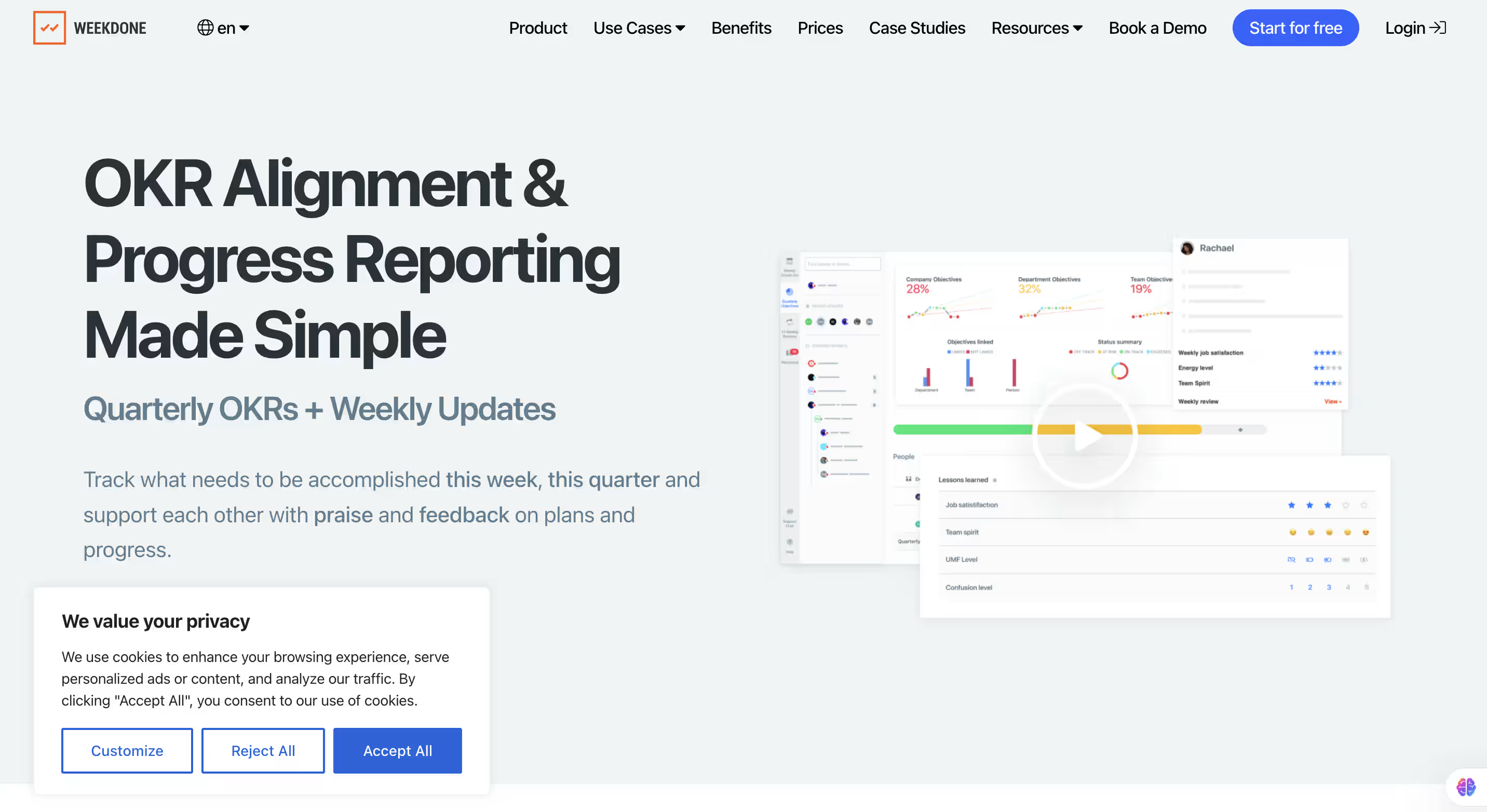
Best for: Teams that want a weekly OKR rhythm with simple check-ins
Overview: Weekdone is built entirely around the weekly check-in — hierarchical and tree views make goals feel like part of the routine rather than a quarterly planning exercise.
Key Features: Automated weekly status reports, 1:1 check-ins tied to goals, visual goal hierarchy.
Limitations: Less suited to very large or complex organizations needing custom workflows.
Pricing: Free for 1–3 users. Paid plans from $9/user/month.
G2 rating: 4.6/5
Best-Fit Summary: Choose Weekdone for affordable, simple OKR tracking with a strong weekly rhythm.
7. 15Five
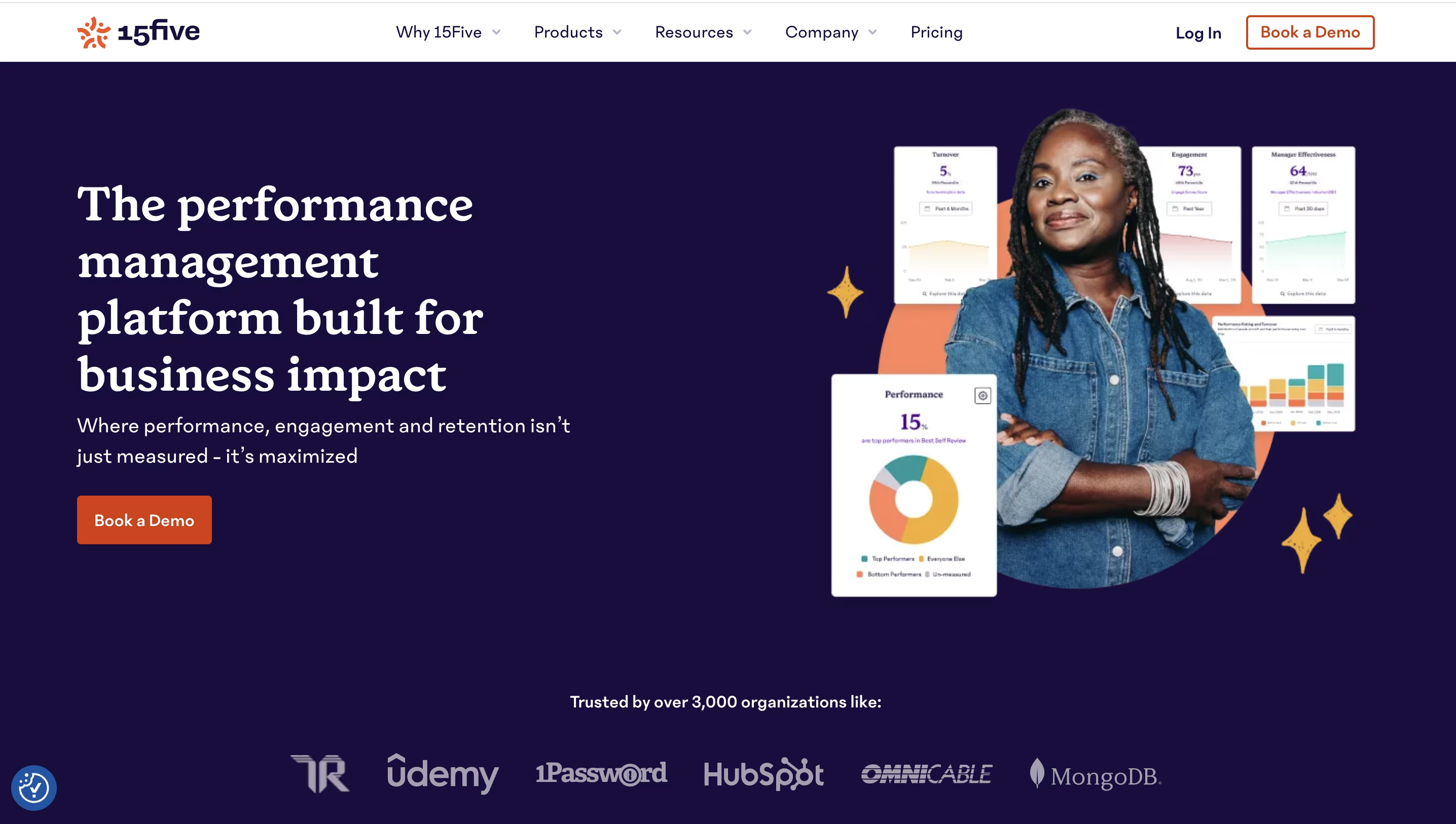
Best for: Manager coaching and weekly check-ins tied to OKRs
Overview: 15Five brings goal tracking into weekly check-ins and coaching conversations. Best for teams wanting OKRs tightly tied to manager coaching; overkill if you only want a high-level OKR dashboard.
Key Features: Spark AI for review-writing and sentiment analysis, continuous check-ins tied to goals, science-backed approach.
Limitations: Some reviewers note gaps versus dedicated OKR-only tools (confidence levels, detailed OKR notes).
Pricing: Engage $4/user/month; Perform (includes OKRs) $11/user/month; Total Platform $16/user/month, billed annually.
G2 rating: 4.6/5
Best-Fit Summary: Choose 15Five for OKRs tied to weekly check-ins and manager coaching.
8. Asana
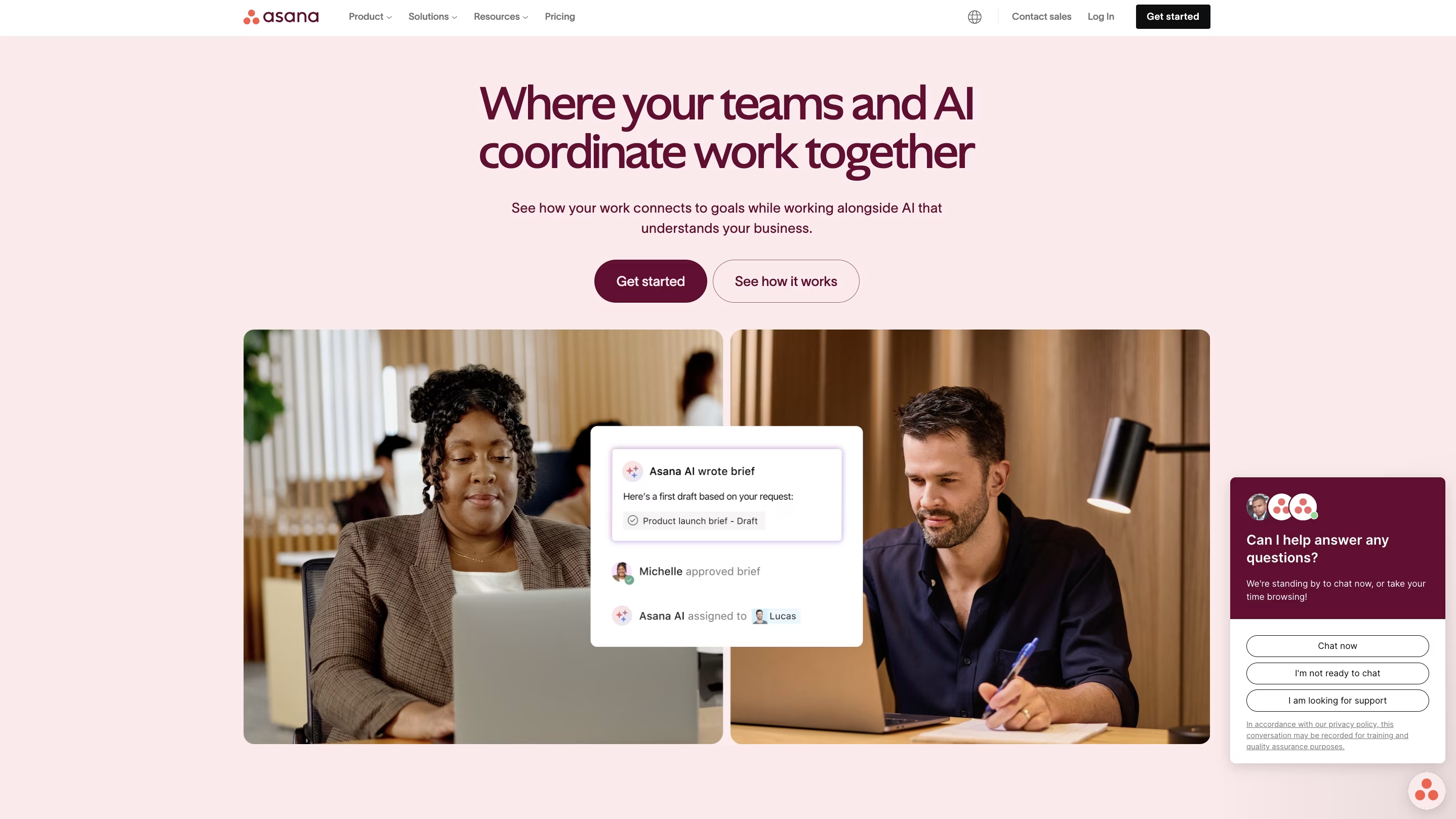
Best for: Teams that need goals connected to projects and tasks
Overview: Asana's Goals feature extends its project-management core into lightweight goal tracking with automatic progress roll-up from linked work. Works best when your team's projects already live in Asana.
Key Features: Task-to-goal connection with automatic roll-up, portfolio view, 200+ integrations.
Limitations: Goal features are not as specialized as dedicated OKR tools.
Pricing: Free for up to 2 users. Starter $10.99/user/month; Advanced $24.99/user/month, billed annually.
G2 rating: 4.3/5
Best-Fit Summary: Choose Asana if your team already uses it for project management and wants goal tracking without switching tools.
9. ClickUp
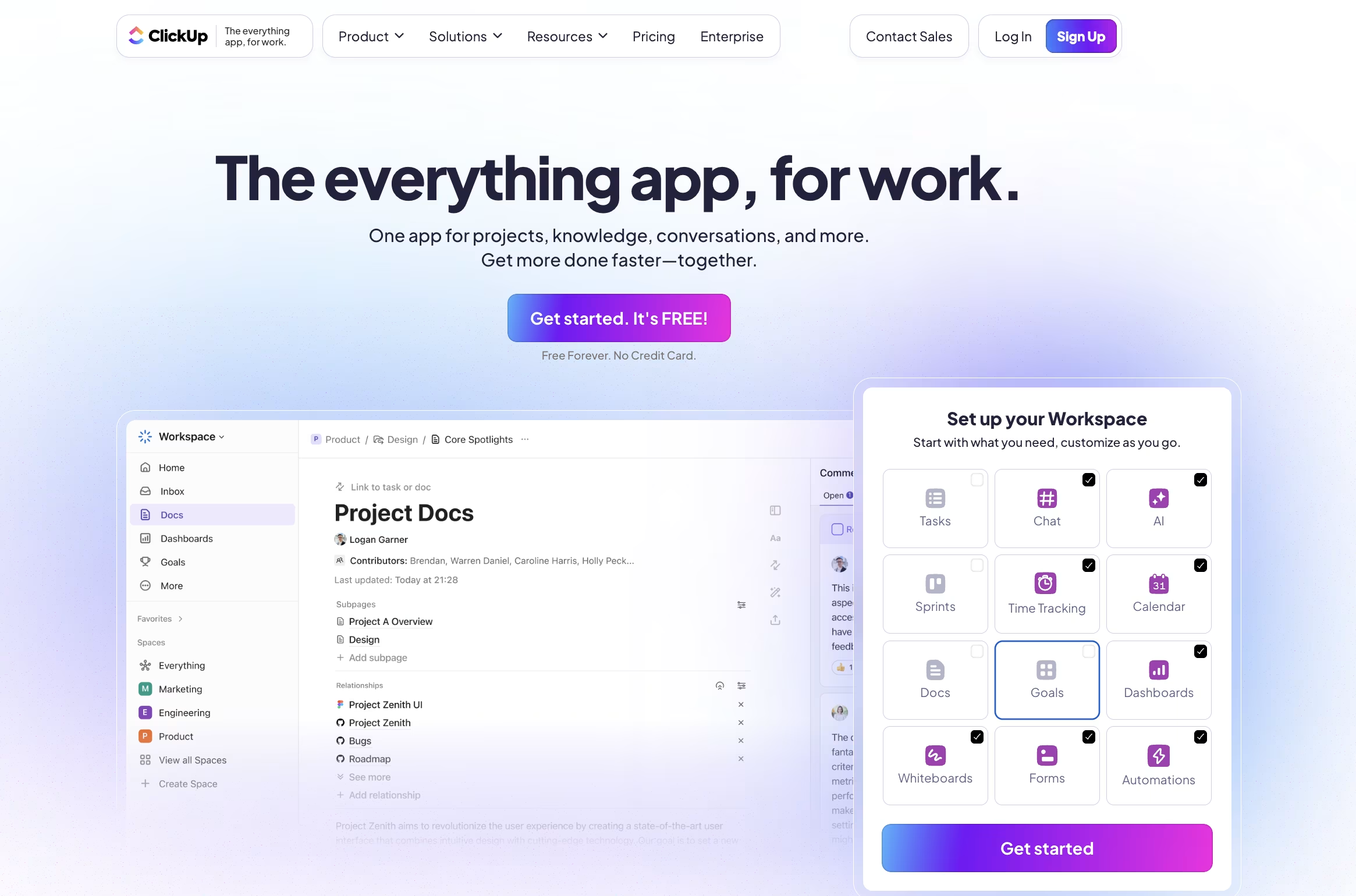
Best for: Productivity-focused teams that want highly customizable goals
Overview: ClickUp works best when your team already runs projects and tasks there — OKRs become another view on existing work rather than a separate system.
Key Features: Flexible goal categories, custom numeric/monetary/true-false targets, task-to-goal linking.
Limitations: Can feel too broad for teams that only need focused OKR tracking.
Pricing: Free forever plan. Unlimited $7/user/month; Business $12/user/month, billed annually.
G2 rating: 4.7/5
Best-Fit Summary: Choose ClickUp if you want a customizable workspace where OKRs are part of a broader work-management system. See ClickUp alternatives if the breadth feels like more than you need.
10. WorkBoard
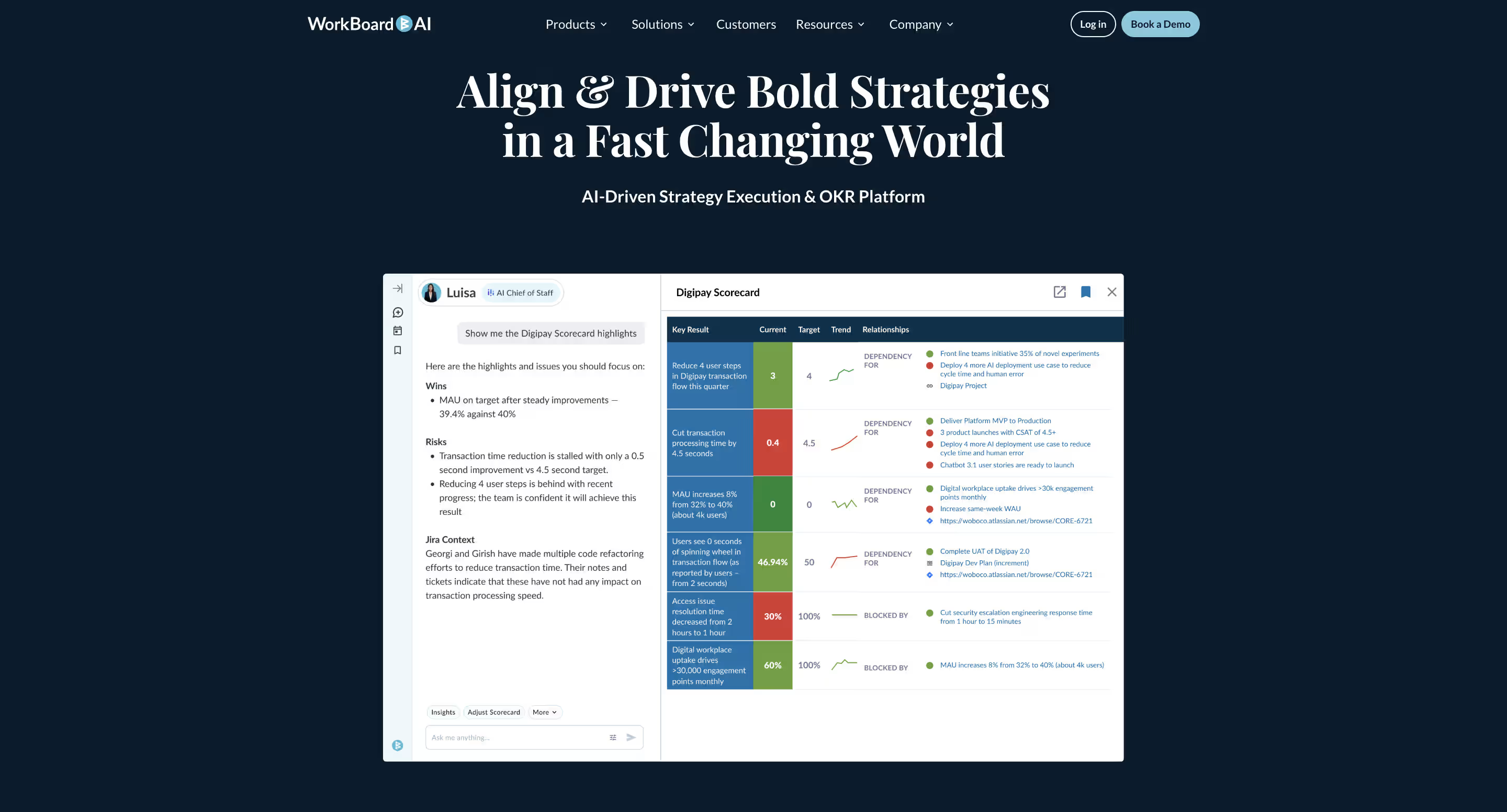
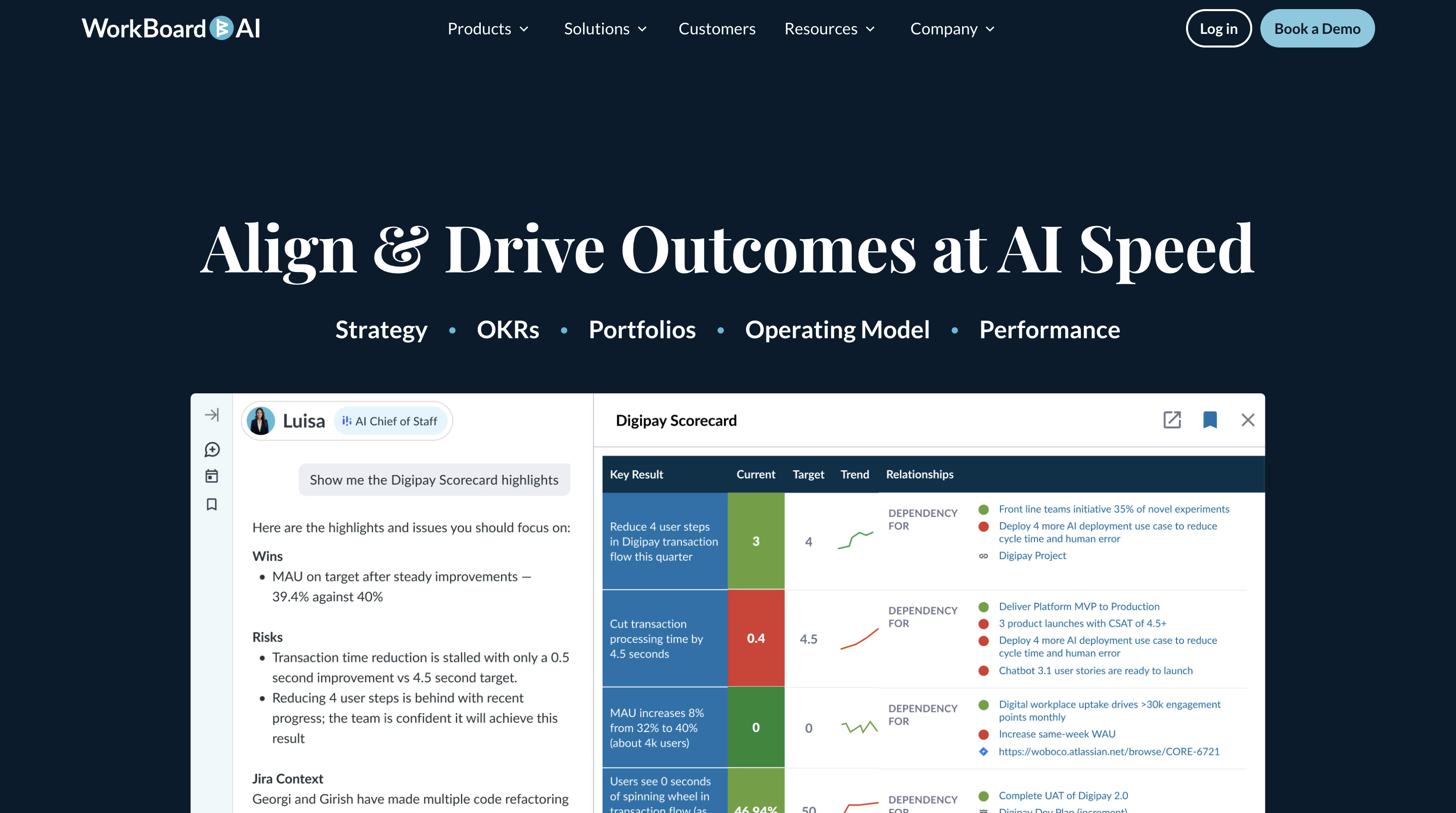
Best for: Enterprise strategy execution with executive-level reporting
Overview: WorkBoard is built for leadership teams wanting a clear line from strategy to execution. Less suited to small teams needing a simple tracker.
Key Features: Generative AI for strategy alignment, executive scorecards and briefings, cross-functional collaboration tools.
Limitations: Overkill for small teams; requires formal rollout and sustained leadership involvement.
Pricing: Not publicly available. Custom quote.
G2 rating: 4.7/5
Best-Fit Summary: Choose WorkBoard for enterprise strategy execution with executive-level reporting.
11. Workleap
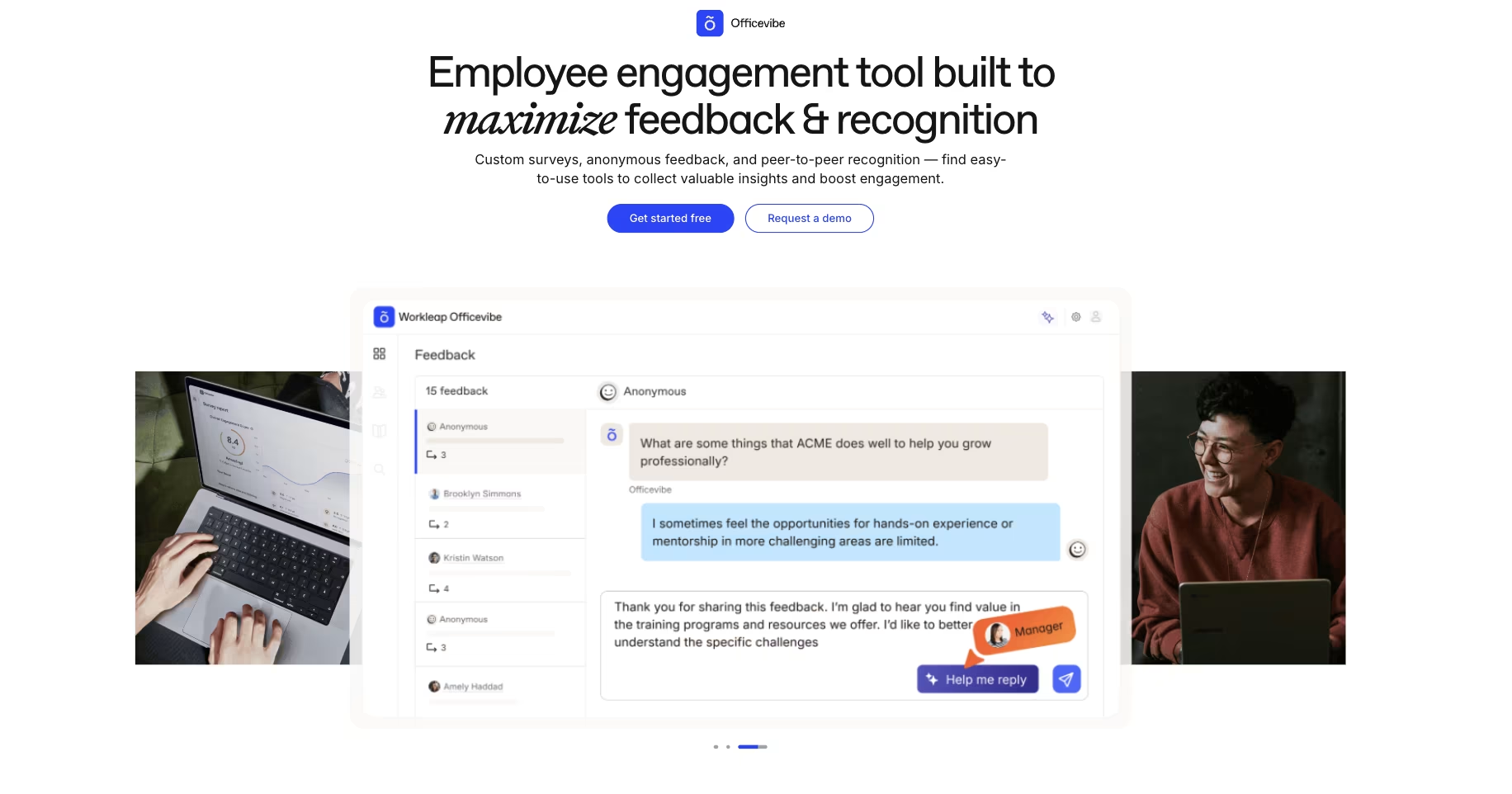
Best for: Startups needing modular, budget-friendly OKR tools
Overview: Works best for small to mid-sized teams wanting a clean experience without a complex enterprise rollout.
Key Features: Visual OKR displays, flexible goal adjustment, continuous performance review support.
Limitations: Not a full HRIS; modular pricing structure can feel confusing initially.
Pricing: Free plan for small teams. Essential $3.50/person/month; Pro $5/person/month.
G2 rating: 4.7/5
Best-Fit Summary: Choose Workleap if you're a startup wanting modular, budget-friendly tools that scale as you grow.
12. Betterworks
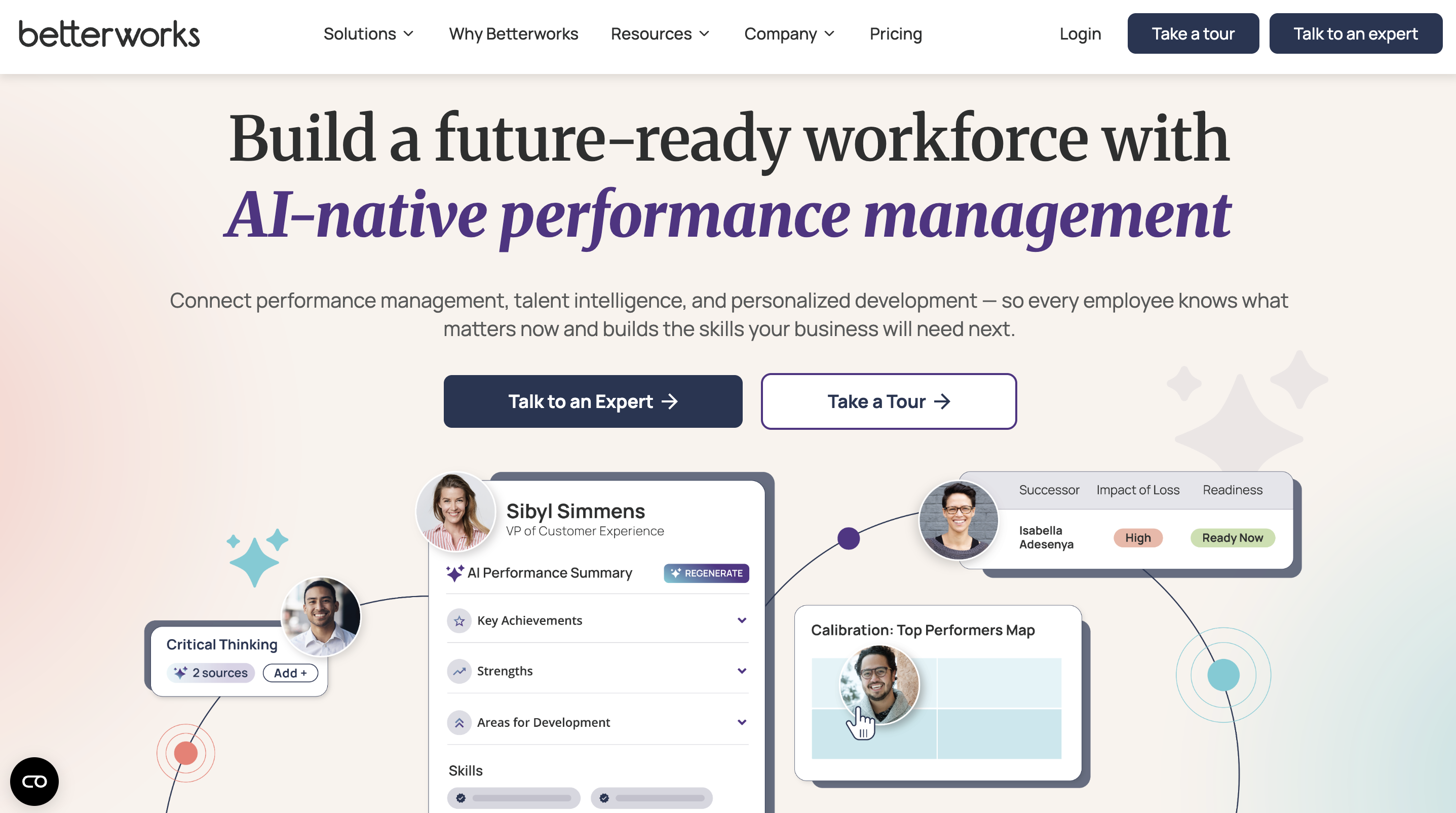
Best for: Enterprises wanting continuous performance management and OKRs in one system
Overview: Combines OKR tracking with continuous performance management for large organizations wanting goal-setting, feedback, and formal reviews in one platform.
Key Features: Continuous feedback tied to goal progress, highly customizable review forms, strong integration capabilities.
Limitations: Pricing isn't publicly disclosed regardless of team size; overkill for small teams.
Pricing: Not publicly disclosed. Custom quote.
G2 rating: 4.3/5 (241 reviews)
Best-Fit Summary: Choose Betterworks if OKRs need to feed directly into formal performance reviews and calibration. If undisclosed pricing is a dealbreaker, see our Betterworks alternatives roundup.
13. Perdoo
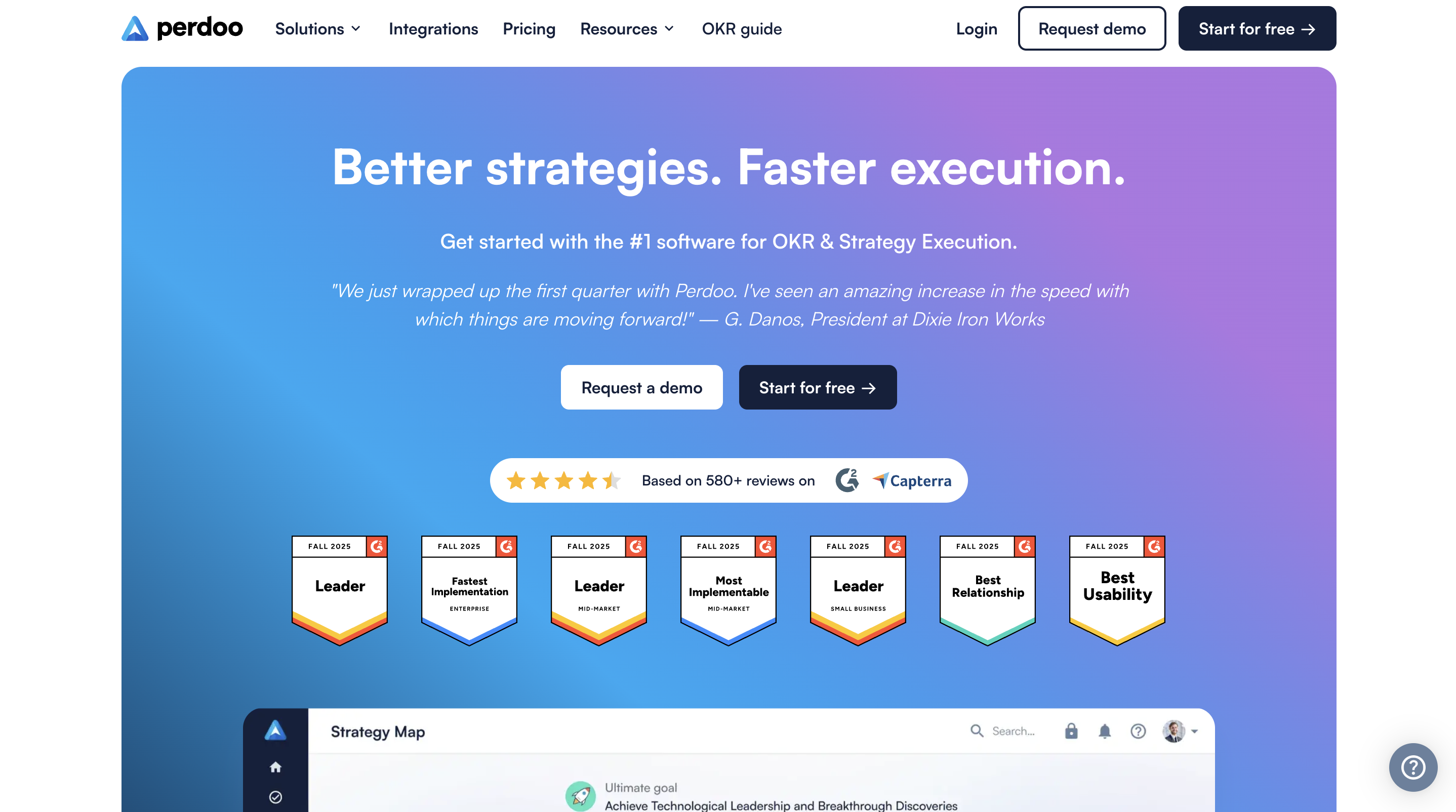
Best for: Teams wanting OKRs explicitly cascaded from a documented company strategy
Overview: Strategy Maps and Cascade Views connect company-level pillars down through team and individual OKRs. Best for organizations starting from strategy and cascading down; a lot for teams wanting a no-frills tracker.
Key Features: Strategy Maps and Cascade Views, KPI tracking alongside OKRs, generous 5-user free tier.
Limitations: Ease-of-use ratings trail lighter competitors on G2.
Pricing: Perdoo offers a free plan for teams of up to 5 users. Paid plans start at €6.40/user/month for Premium and €8/user/month for Supreme, billed annually. View-only licenses are available on Supreme at €1.50/user/month, and the per-user price goes down as you add more licenses.
G2 rating: 4.4/5
Best-Fit Summary: Choose Perdoo if you want OKRs visibly tied to a company strategy map and can use the free tier.
14. Peoplebox
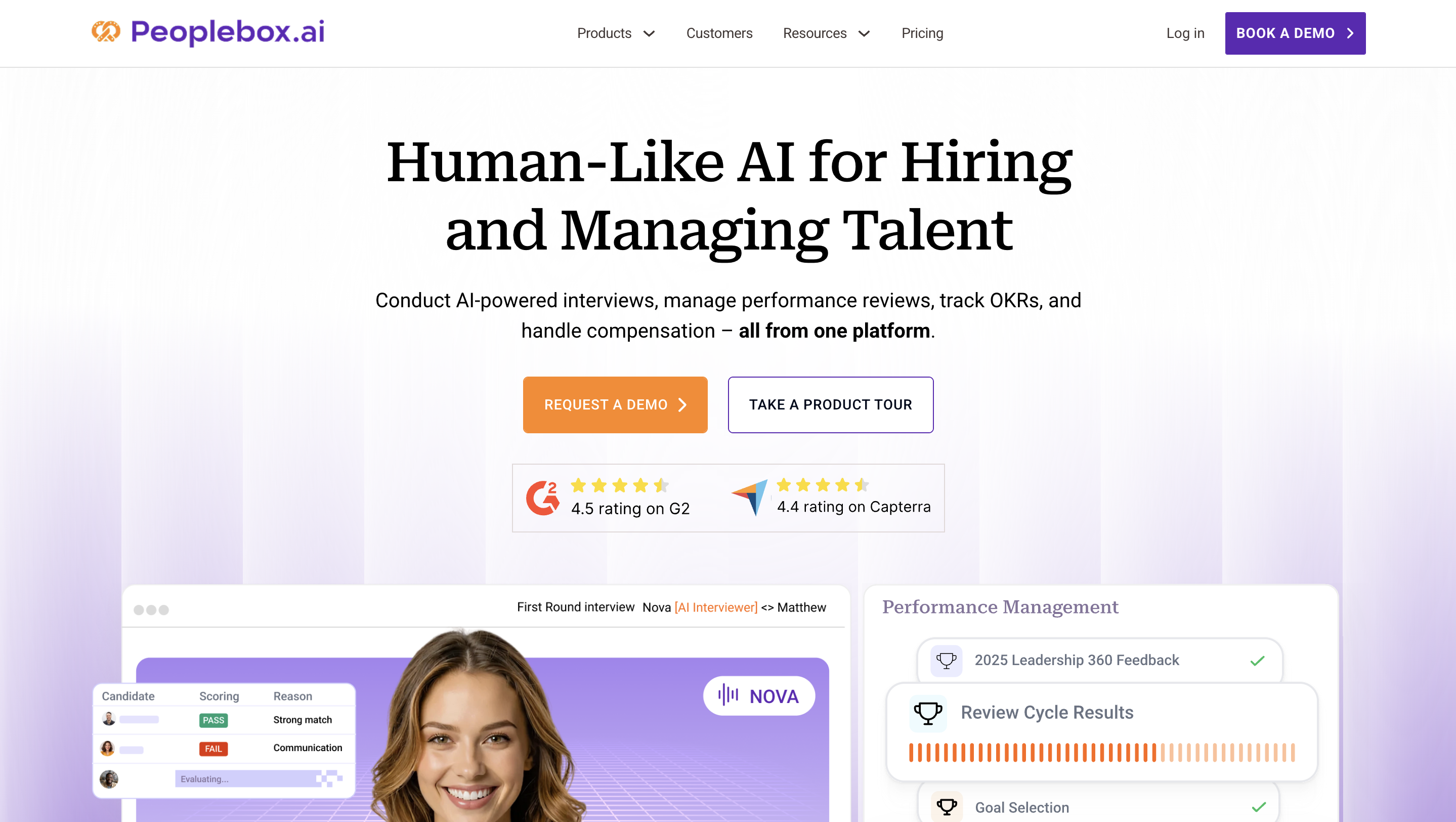
Best for: Teams wanting OKRs bundled with business reviews and project management
Overview: Combines OKR tracking with business review workflows and KPI dashboards, aimed at teams wanting goal check-ins inside existing review cadences.
Key Features: Transparent published pricing, modular OKR/Performance/Full-Suite plans, business review and KPI-board features uncommon in pure OKR tools.
Limitations: Less performance-management depth than dedicated tools like Lattice.
Pricing: OKR Platform $8/user/month; Full Suite Professional $12; Full Suite Premium $15; Enterprise custom.
G2 rating: 4.5/5 (365 reviews)
Best-Fit Summary: Choose Peoplebox for OKRs bundled with business reviews under transparent, modular pricing.
15. Quantive
Best for: Microsoft-ecosystem enterprises, especially those migrating off the retired Viva Goals
Overview: Quantive (formerly Gtmhub) is a strategy execution platform with native Microsoft Teams, Azure DevOps, and Power BI integrations. Microsoft retired Viva Goals on December 31, 2025; Quantive positions itself as the direct migration path.
Key Features: Deep Microsoft ecosystem integration, dedicated Viva Goals migration tooling, AI-powered planning dashboards.
Limitations: Standard pricing isn't public; best fit skews toward large orgs already invested in Microsoft tools.
Pricing: Not publicly listed. Migration-specific promotional pricing available for former Viva Goals customers — verify current terms.
G2 rating: 4.6/5 (203 reviews)
Best-Fit Summary: Choose Quantive if you're Microsoft-native or migrating off Viva Goals. If you're specifically evaluating what replaces Viva Goals, see Microsoft Viva Goals alternatives for the fuller comparison.
Best OKR Software by Use Case
Already spotted your use case in the table above? If it pointed you toward ThriveSparrow, you can start tracking your first OKR cycle free for 14 days — no credit card, no sales call.
What to Look for in OKR Software
- Goal alignment and cascading — visual maps showing how individual work connects to company priorities.
- Reporting depth — dashboards by team and department, with drill-down, not just a single rollup number.
- Integrations — Slack, Microsoft Teams, Jira, or your HRIS; if updating goals requires a separate login, adoption drops.
- Performance management connection — decide upfront whether you want OKRs feeding reviews and development plans, or standing alone.
How Much Does OKR Software Cost?
Three pricing patterns show up across this list:
- Published per-user pricing — ThriveSparrow, Weekdone, Asana, ClickUp, Workleap, Peoplebox, Perdoo all list real numbers, generally $2–$16/user/month depending on modules.
- Modular add-on pricing — Lattice and 15Five price OKRs separately from performance, engagement, and other modules, so total cost depends on what you bundle.
- Custom/enterprise quotes — Culture Amp, Leapsome, Profit.co, WorkBoard, Betterworks, and Quantive don't publish rates; expect a sales cycle before you see numbers, and factor that time cost into your evaluation.
Final Verdict
Not every team needs dedicated software here — if you have fewer than 5 people with simple goals, or your real problem is task tracking rather than goal alignment, a spreadsheet or a tool like Asana may genuinely be enough. If you're not sure how to even structure your first OKRs, try our free OKR generator before committing to a tool. For everyone else:
- Choose ThriveSparrow if you want OKRs connected to performance reviews, engagement, and feedback in one platform.
- Choose Lattice if performance management is the priority and you have time for a heavier rollout.
- Choose Profit.co if you want a dedicated OKR platform with AI-assisted templates.
- Choose Weekdone if you want simple weekly check-ins without complexity.
- Choose Asana or ClickUp if goals need to live inside daily project work.
Take advantage of free trials before committing — testing hands-on tells you more about fit than any comparison article, including this one.
You've now seen all 15. If none of the trade-offs above ruled out ThriveSparrow — goals connected to performance and engagement, published pricing, no enterprise sales cycle — set up your first OKR cycle free for 14 days and see the alignment tree fill in.
FAQs
1. What is the best OKR software?
Depends on team size and needs. For HR teams wanting OKRs connected to performance and engagement, ThriveSparrow starts at $3/employee/month. For enterprises, Lattice or WorkBoard.
2. What is the best OKR software for startups?
ThriveSparrow, Weekdone, and Workleap all publish transparent, affordable pricing with fast setup.
3. What is the best OKR software for enterprises?
Lattice integrates OKRs with performance management at scale; WorkBoard and Quantive focus on strategy execution with executive reporting.
4. What is the cheapest OKR software?
Workleap, Asana (up to 2 users), ClickUp, and Perdoo (up to 5 users) offer free plans. For paid tiers, ThriveSparrow Goals starts at $3/employee/month.
5. Which OKR software integrates with Slack?
ThriveSparrow, Lattice, Profit.co, Weekdone, and Asana all support native Slack integration.
6. Which OKR software integrates with Microsoft Teams?
Quantive has the deepest native Teams integration, built for Microsoft-first organizations. ThriveSparrow and Lattice also connect to Teams for goal updates.
7. Can I use OKR software for performance reviews?
Yes — ThriveSparrow, Lattice, Leapsome, and 15Five all connect OKRs directly to performance reviews and development plans.
8. Do I need OKR software if I use spreadsheets?
Spreadsheets work for small teams with simple goals but break down at scale — OKR software adds real-time tracking, reminders, and manager dashboards without manual version control.